
Your Retirement Plan Needs Liquidity
A retirement balance can look solid and still leave too little money within easy reach. A liquidity layer helps preserve choices when health, home, caregiving, or income surprises arrive.
Retirement planning often centers on a single question: How much have you saved? That number matters, but it does not answer a second question that becomes more important with age: How much of your plan can respond quickly when life changes?
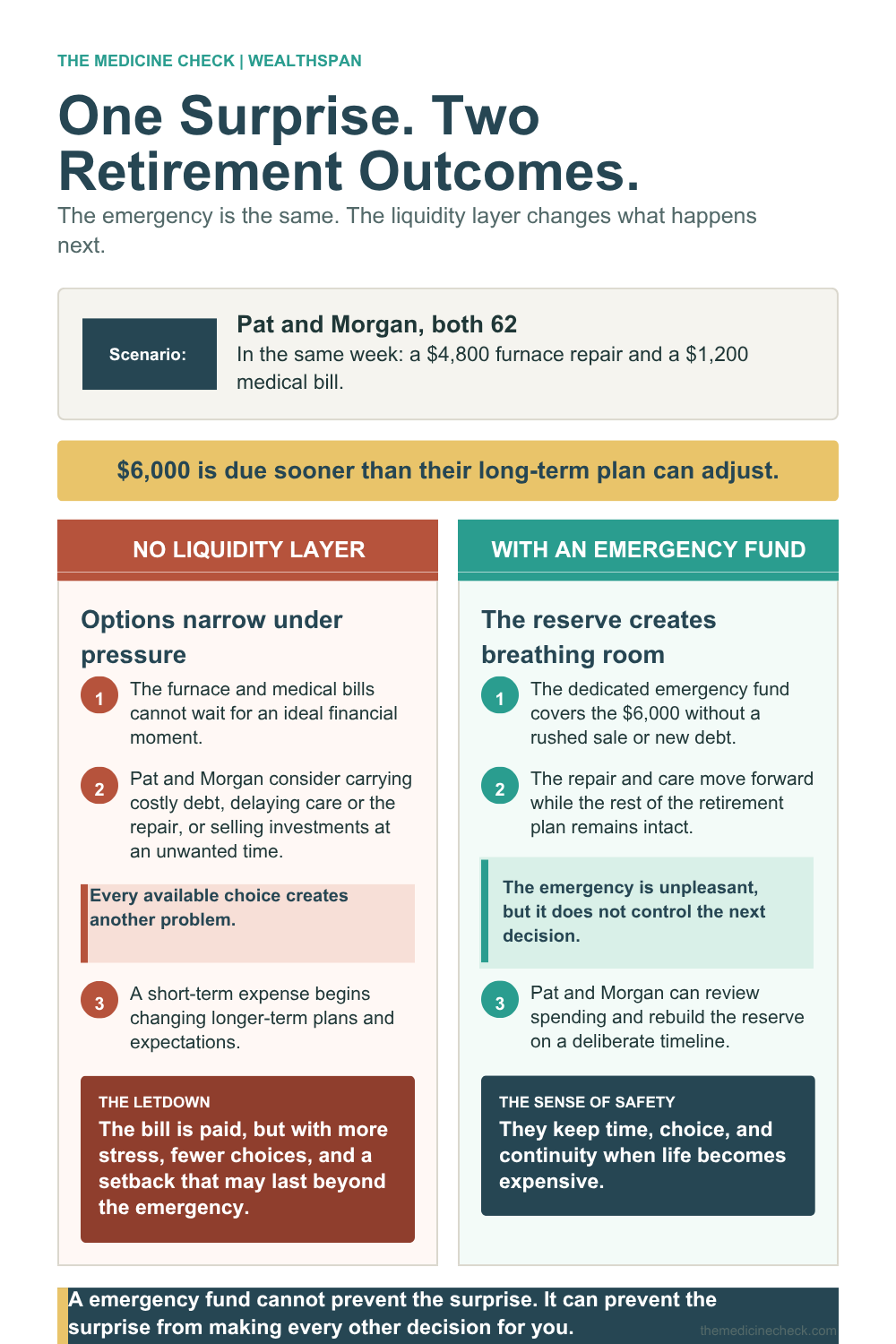
A household can have substantial retirement assets and still feel financially cornered if most of the money is difficult, costly, or poorly timed to access. A sudden dental bill, a broken furnace, a period of family caregiving, or a temporary loss of income can force decisions that were never part of the long-term plan.
That is why a retirement plan needs some liquidity: money that is available for near-term needs without forcing a rushed investment sale, new debt, or a major change to the retirement strategy. Liquidity is not the whole plan. It is the part that helps the rest of the plan stay intact.
Liquidity is about access, not just account size
In plain language, liquidity means the ability to turn an asset into spendable money quickly and with limited friction. Cash in an insured deposit account is highly liquid. A home may be valuable, but using that value can require a sale, a loan, time, fees, and approval. Retirement accounts may be accessible, yet withdrawals can create taxes, penalties before certain ages, or undesirable timing when markets are down.
The Consumer Financial Protection Bureau describes an emergency fund as a cash reserve set aside for unplanned expenses or financial emergencies. Its guidance emphasizes a dedicated, safe, and accessible place for that money. Fidelity similarly frames emergency savings around essential expenses and notes that the right amount varies with job security, household needs, and personal circumstances.
Those principles still matter in retirement, but the purpose broadens. The reserve is no longer only a bridge after a lost paycheck. It may also be a bridge around a health event, a home modification, family support, insurance timing, or a market decline.
Why aging changes the shape of financial surprises
Some expenses become easier to predict with age; others become less predictable. Medicare and supplemental coverage can make routine costs more visible, but they do not remove every bill. Medicare generally does not cover most long-term custodial care, and dental, vision, hearing, home support, and caregiving needs can create separate exposure depending on coverage and circumstances.
At the same time, households may have less ability or desire to replace money through additional work. A home repair can become a safety or mobility issue rather than a cosmetic project. Helping a spouse, parent, or adult child may change travel, housing, or work decisions. Even a temporary disruption can affect independence.
Liquidity matters because it buys time. Time allows a household to compare options, check insurance coverage, consult a clinician or benefits counselor, speak with a tax or financial professional, and avoid making several irreversible decisions at once.
A liquidity layer is not the same as “keep more cash”
There is no universal cash target that fits every household. Holding too little can make the plan brittle. Holding far more than needed can create its own tradeoffs, including lost growth potential and inflation risk. The right question is not whether cash is always better. It is what near-term risks the household wants to absorb without disturbing longer-term assets.
A liquidity layer also does not replace insurance, long-term care planning, a diversified retirement portfolio, or a sustainable spending plan. It works beside those tools. Insurance transfers selected risks. Savings fund expected goals. Long-term investments support future spending. Liquidity handles the timing gap when a need arrives before the rest of the plan can respond calmly.
Four questions for a retirement liquidity review
What must be paid every month? Start with the spending floor: housing, utilities, food, insurance, transportation, medications, taxes, debt payments, and other expenses that cannot easily pause. This is the base the reserve may need to protect.
Which costs could arrive quickly? Map the plausible shocks, not every imaginable disaster. Health deductibles and uncovered care, urgent home or vehicle repairs, caregiving travel, family support, and a temporary income interruption are common categories.
Which money is truly easy to reach? Identify where funds are held, how long access takes, what taxes or penalties may apply, whether market prices could be unfavorable, and who can access the account if the usual decision-maker is ill or unavailable.
How will the reserve be rebuilt after it is used? A reserve without a replenishment rule can quietly disappear. The review should define when to pause optional spending, redirect incoming cash, or revisit the target after a major life change.
A practical way to organize the layer
A useful review separates three kinds of money that are often blurred together:
Operating cash covers normal bills and near-term spending already expected.
A shock reserve covers unplanned costs that need a fast response.
Planned short-term funds cover known expenses such as taxes, insurance premiums, travel, home projects, or a vehicle replacement.
Keeping these purposes distinct can prevent a false sense of security. A large checking balance may already be committed to upcoming bills. A large retirement balance may be subject to taxes, investment risk, or distribution rules. A home can add net worth without adding immediate flexibility.
Accessibility deserves its own check. The Internal Revenue Service notes that early distributions from many retirement plans may face an additional tax unless an exception applies. The Federal Deposit Insurance Corporation explains that deposit insurance generally covers up to $250,000 per depositor, per insured bank, for each ownership category. These are not reasons to choose one account over another; they are reminders to understand how each account works before it is needed.
Make the review part of an annual Wealthspan check-in
Liquidity changes as work ends, Social Security begins, a mortgage is paid off, health coverage changes, a spouse dies, or caregiving responsibilities grow. A reserve that fit five years ago may no longer match the household’s spending floor or its most likely shocks.
Once a year, review the essential monthly total, the location and accessibility of the reserve, account ownership and beneficiaries, insurance deductibles, healthcare exposure, and the people who could help manage finances during an illness.
Practical takeaway
Retirement readiness is not only the ability to fund many years. It is also the ability to handle the next difficult month without sacrificing future choices. A liquidity layer will not eliminate uncertainty, but it can keep a health expense, home repair, or caregiving need from dictating a larger decision under pressure.
The most useful next step is not to chase a generic cash target. It is to identify the household’s spending floor, realistic near-term shocks, truly accessible money, and a replenishment plan. That is financial resilience in service of independence.
Keep Building Your Wealthspan
Estimate future medical costs with the Retirement Healthcare Spend Estimator.
Model savings decisions with the Retirement Savings Calculator.
Track both money and health trends in the Annual Wealthspan + Healthspan Checkup Tracker.
-
Consumer Financial Protection Bureau. An essential guide to building an emergency fund. https://www.consumerfinance.gov/an-essential-guide-to-building-an-emergency-fund/
Fidelity. How much emergency savings should I have? https://www.fidelity.com/viewpoints/personal-finance/save-for-an-emergency
Medicare.gov. Long-term care coverage. https://www.medicare.gov/coverage/long-term-care
Internal Revenue Service. Retirement topics: Tax on early distributions. https://www.irs.gov/retirement-plans/plan-participant-employee/retirement-topics-tax-on-early-distributions
Federal Deposit Insurance Corporation. Deposit Insurance FAQs. https://www.fdic.gov/resources/deposit-insurance/faq/
Fidelity. How to plan for rising health care costs. https://www.fidelity.com/viewpoints/personal-finance/plan-for-rising-health-care-costs