
Can Volunteering Help Protect Memory as We Age?
A new 10-year study links volunteering with better subsequent memory performance in older adults. The signal is encouraging, but it is not proof that volunteering prevents dementia.
A meaningful role may be doing more than filling the calendar
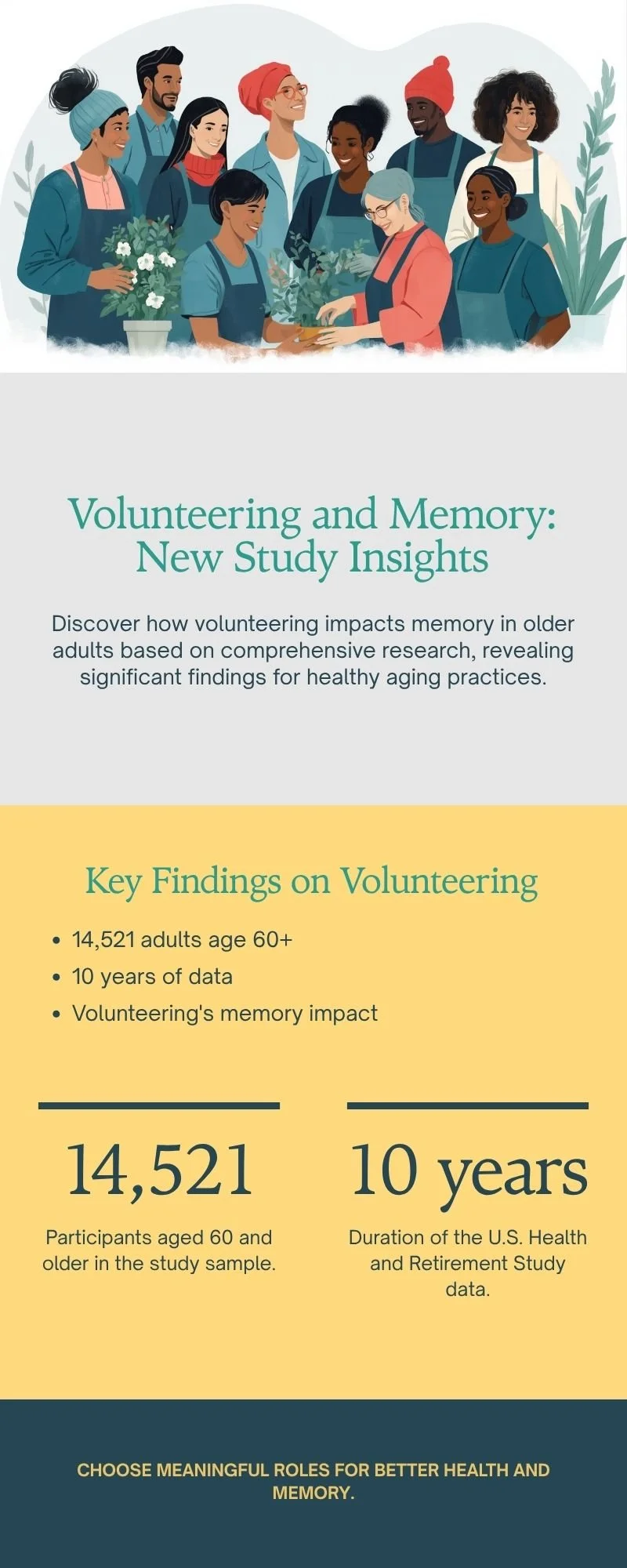
Could volunteering support memory as we age? A study published August 1, 2026, offers an encouraging clue. Researchers followed 14,521 U.S. adults age 60 and older across a decade of Health and Retirement Study data. People who volunteered went on to perform better on objective memory measures at later assessments. The reverse pattern was not found in the same way: objective memory did not predict later volunteering.
That direction matters because it makes the finding harder to dismiss as a simple snapshot in which people with better memory are merely more likely to volunteer. It still does not establish cause and effect. The study was observational, not a trial that randomly assigned people to volunteer or not volunteer. Health, education, income, mobility, personality, community access, and social networks may still help explain part of the association.
The most reasonable takeaway is neither “volunteering prevents dementia” nor “this is just correlation and therefore meaningless.” It is that meaningful participation deserves a place in the Healthspan conversation alongside exercise, sleep, blood pressure, hearing, metabolic health, and other better-established influences on cognitive aging.
What the new study actually did
Cheng-Cheng Niu and Jing Yu analyzed nationally representative data collected from 2010 through 2020. They examined formal volunteering, such as service through an organization, and informal volunteering, such as helping outside a formal group. They also looked at two different kinds of memory information: objective performance on memory testing and people’s own ratings of their memory.
The researchers used longitudinal statistical models designed to separate stable differences between people from changes occurring within the same person over time. In plain language, they asked more than whether volunteers had better memory. They examined whether volunteering at one point predicted memory at a later point, and whether memory predicted later volunteering.
Across the decade, both formal and informal volunteering declined. Volunteering and memory also tended to move in the same direction over time. Most notably, volunteering predicted subsequent objective memory, while objective memory did not predict subsequent volunteering. The subjective-memory pattern was different: people’s own memory ratings predicted later volunteering, and only formal volunteering predicted later subjective memory.
Those differences are useful. Objective memory testing and the feeling that one’s memory is changing are related, but they are not interchangeable. Mood, confidence, stress, sleep, and expectations can influence subjective memory. The study therefore supports a careful claim about later memory performance, not a claim that volunteering prevents Alzheimer disease or other dementias.
Why volunteering might matter for Healthspan
Volunteering can combine several forms of engagement that are difficult to reproduce with a single health task. A recurring role may require remembering names and schedules, solving small problems, communicating, moving through the community, and adapting to other people. It can also create structure, responsibility, purpose, and social contact.
Any of those features could matter for cognitive resilience. They could also work together. A person who volunteers may leave home more often, walk more, maintain a broader social network, or feel more accountable to a routine. Earlier research has linked volunteering with cognitive, social, and physical activity, but the precise mechanism remains unsettled.
This is also why “volunteering” should not be treated as a pill with a standard dose. Roles differ enormously. Serving meals, tutoring, maintaining a community garden, helping at a library, calling isolated neighbors, and doing remote administrative work place different demands on attention, movement, stress, and social interaction. The new study did not identify an ideal number of hours, a best type of role, or a threshold that changes dementia risk.
How strong is the evidence?
Evidence verdict: moderate. The study is large, nationally representative, longitudinal, and unusually attentive to directionality. A 2024 systematic review also concluded that volunteering was positively correlated with cognitive performance in older adults, although results varied with factors such as sex and education. A smaller study of 91 retired adults found that volunteering at least monthly was associated with better working memory and greater social and cognitive activity.
The consistency is reassuring, but the evidence remains mostly observational. People who can volunteer may already have advantages in health, transportation, free time, education, finances, community access, and social support. Statistical adjustment can reduce those differences but cannot remove every unmeasured factor. The new paper also examined memory performance, not incident mild cognitive impairment, dementia, independence, or day-to-day function. Its abstract does not provide an effect size that can be translated into a clinically meaningful number of words remembered or years of decline delayed.
A randomized trial with sustained participation, clear cognitive and functional outcomes, and long follow-up would provide stronger evidence. Until then, volunteering is best framed as a promising form of meaningful engagement with several plausible benefits, not as a stand-alone brain-health treatment.
A practical way to use this finding
The goal is not to add another obligation to a crowded healthy-aging checklist. It is to notice whether life contains roles that are meaningful, mentally active, socially connected, and sustainable.
Choose meaning before minutes. A role that fits your interests and values is more likely to last than one selected only because it sounds healthy.
Favor a repeatable rhythm. A modest recurring commitment may create more structure and relationship than an occasional burst of activity, although the study did not establish a required frequency.
Match the role to current capacity. Remote, seated, low-sensory, short-shift, and transportation-supported roles count. Volunteering should not worsen pain, fatigue, fall risk, or caregiver strain.
Pay attention to barriers. New difficulty with transportation, hearing, vision, mobility, energy, or remembering commitments may be useful information to bring to a health review.
Keep the foundations in place. Volunteering complements rather than replaces physical activity, sleep care, vascular risk management, hearing treatment, medication review, and appropriate medical evaluation.
A yearly check-in can help connect these domains. The Annual Wealthspan + Healthspan Checkup Tracker provides one place to review measurable health trends, function, goals, and the practical supports that make participation possible.
The Healthspan takeaway
Memory is not preserved by one habit, and meaningful work is not valuable only when it improves a test score. Still, this study adds weight to a useful idea: staying connected to roles that ask something of us may be part of staying cognitively engaged.
For someone who wants to volunteer and can do so without sacrificing health or stability, the new evidence is one more reason to make that role accessible and sustainable. For someone who cannot volunteer, the study should not become a source of guilt. Similar ingredients—purpose, social contact, learning, responsibility, and routine—can be built through family, community, creative work, caregiving, clubs, faith communities, and paid work. The research supports the pattern of engagement more than any single label.