
Measure What Keeps You Independent
A new Lancet Healthy Longevity study adds weight to a simple Healthspan idea: the capacities that let you move, think, sense, and manage daily life deserve regular attention before disability appears.
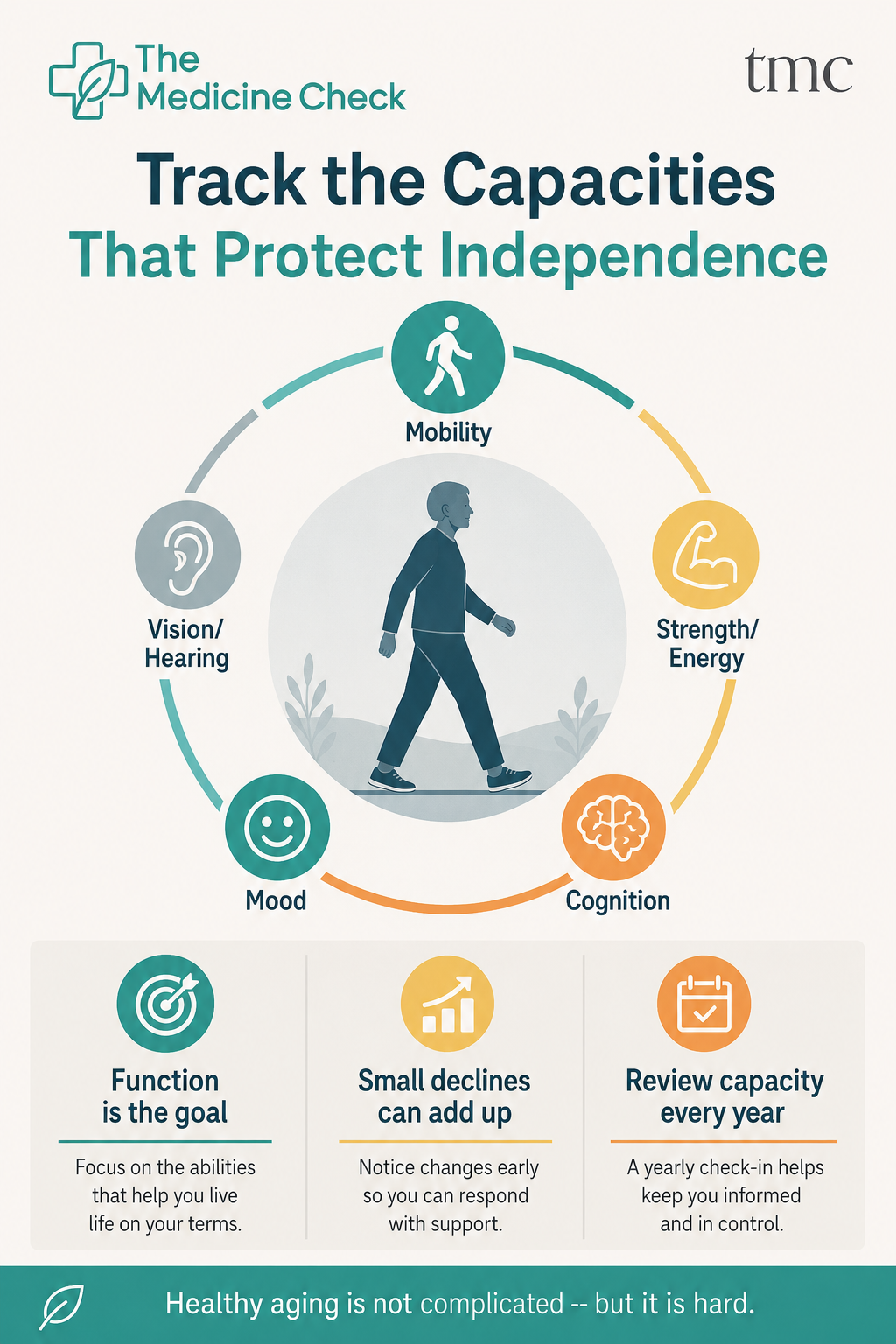
Editorial infographic titled “Track the Capacities That Protect Independence,” showing five healthspan domains around an older adult walking, with three annual-review reminders for preserving independence.
The new healthspan lesson: measure capacity, not just disease
Healthy aging is often described through numbers: cholesterol, blood pressure, glucose, weight, bone density, medication lists, and screening dates; those numbers still matter, but this week’s strongest Healthspan development points to something more basic: the abilities that let a person keep living independently.
A new decedent cohort study (a study of people who have already passed) in The Lancet Healthy Longevity looked at intrinsic capacity among older adults before death. Intrinsic capacity is the combined physical and mental capacity a person can draw on: mobility, cognition, psychological health, sensory function, and vitality or energy. In everyday terms, it is the reserve that helps you walk, think, hear, see, recover, make decisions, manage daily tasks, and stay connected to life. Healthspan is not simply how long disease can be postponed: It is how long function, independence, cognition, mobility, strength, and quality of life can be preserved.
What the new study found
The new Lancet Healthy Longevity paper analyzed data from 746 adults age 70 and older in the Precipitating Events Project who had died by November 2024. Researchers tracked intrinsic capacity over time using 25 self-reported and physical-performance measures. Disability was assessed monthly and defined as dependence in instrumental activities of daily living, also referred to as more complex tasks needed to live independently.
The pattern was not subtle. Average intrinsic capacity declined over the final 20 years of life, from about 80 points to 47 points on a 0-to-100 scale. Disability did not rise in a perfectly straight line, but the relationship between lower capacity and disability became stronger as people approached death. In the final four years of life, each 10-point higher intrinsic capacity score was associated with roughly 47% to 48% lower odds of disability.
That does not mean a 10-point improvement would automatically cut disability risk in half. This was an observational cohort study, not a trial assigning people to a capacity-building intervention. But it does suggest that capacity is not an abstract research term. It tracks closely with the thing many people care about most: whether they can keep managing daily life.
Why intrinsic capacity fits the Healthspan frame
The World Health Organization defines healthy aging around functional ability: the ability to be and do what people value. Functional ability is shaped by a person’s intrinsic capacity, their environment, and the interaction between the two.
That framing is useful because it moves healthy aging away from a single-disease checklist. A person can have a diagnosis and still function well if the condition is controlled, the environment is supportive, and the person’s capacity is protected. Another person can have “normal” lab results but still be losing healthspan if walking speed, balance, cognition, hearing, vision, mood, sleep, or nutrition are slipping.
This is the practical shift: instead of asking only, “What diseases do I have?” a Healthspan check-in also asks, “What capacities am I relying on, and are any of them quietly declining?”
The broader evidence is consistent, but still not causal
The new paper fits a larger body of evidence. A 2024 systematic review and meta-analysis in The Lancet Healthy Longevity included 37 longitudinal studies with more than 206,000 participants. It found that higher intrinsic capacity was associated with lower risk of future functional decline and lower mortality risk. Maintained or improved intrinsic capacity over time was also associated with lower impairment in instrumental activities of daily living.
That is meaningful, but it still needs careful language. Most of the evidence is observational. People with better intrinsic capacity may also differ in income, education, access to care, nutrition, neighborhood safety, medical burden, social support, and lifetime opportunity. Those factors can influence both capacity and disability.
So the responsible takeaway is not “track these five things and you will prevent disability.” The better takeaway is: intrinsic capacity appears to be a useful way to organize healthy-aging risk, spot early declines, and guide conversations about prevention before independence is already threatened.
What to track in a yearly Healthspan review
A practical intrinsic-capacity check does not need to be complicated. It should be structured enough to notice change, but simple enough to repeat every year.
Start with five domains:
Mobility and balance: walking speed, stairs, falls, getting up from a chair, carrying groceries, confidence moving outside the home
Strength and vitality: energy, fatigue, appetite, unintentional weight change, muscle strength, recovery after illness
Cognition: memory, attention, planning, medication management, finances, driving or navigation concerns
Mood and social connection: depressive symptoms, anxiety, loneliness, motivation, meaningful activity
Vision and hearing: ability to see, hear, communicate, read labels, follow conversations, and avoid isolation
For readers who want a structured place to put this kind of review, The Medicine Check Annual Wealthspan + Healthspan Checkup Tracker is a natural next step.
What this does not mean
This study should not be turned into a personalized medical scorecard or a reason to panic about normal aging. It also should not be used to sell unproven anti-aging programs.
Intrinsic capacity is a framework, not a diagnosis. A lower score or a noticeable decline should lead to better questions, not self-blame. Is pain limiting movement? Is hearing loss making social life harder? Is poor sleep affecting memory? Are medications causing dizziness or fatigue? Is nutrition supporting muscle? Is the home environment making activity easier or harder?
Those are clinician, pharmacist, physical therapy, occupational therapy, nutrition, vision, hearing, and caregiving conversations. The value of tracking capacity is that it can make those conversations happen earlier.
The practical takeaway
The most useful Healthspan habit is not chasing every new longevity headline. It is noticing the abilities that make independence possible and protecting them while there is still room to act.
This week’s evidence supports a calmer, more functional version of prevention: review capacity every year; take changes seriously; connect small declines to practical support; and remember that healthy aging is measured by what life still lets you do.
Keep Building Your Healthspan
Track your yearly progress with the Annual Wealthspan + Healthspan Checkup Tracker.
If medications are part of the story, review your list with the Anticholinergic Burden Calculator.
References
Malkowski OS, Davis-Plourde K, Western MJ, Gill TM. Association between intrinsic capacity and disability before death among older adults: a decedent cohort study. The Lancet Healthy Longevity. 2026. DOI: 10.1016/j.lanhl.2026.100854. https://doi.org/10.1016/j.lanhl.2026.100854
Sanchez-Sanchez JL, Lu W-H, Gallardo-Gomez D, et al. Association of intrinsic capacity with functional decline and mortality in older adults: a systematic review and meta-analysis of longitudinal studies. The Lancet Healthy Longevity. 2024;5(7):e480-e492. DOI: 10.1016/S2666-7568(24)00092-8. https://doi.org/10.1016/S2666-7568(24)00092-8
World Health Organization. Healthy ageing and functional ability. https://www.who.int/news-room/questions-and-answers/item/healthy-ageing-and-functional-ability
World Health Organization. Integrated care for older people (ICOPE). https://www.who.int/teams/maternal-newborn-child-adolescent-health-and-ageing/ageing-and-health/integrated-care-for-older-people-icope
World Health Organization. Integrated care for older people: guidelines on community-level interventions to manage declines in intrinsic capacity. 2017. https://www.who.int/publications/i/item/9789241550109