
The Financial Side of Illness Nobody Talks About
Summary
When illness enters your life, the focus is naturally on diagnosis, treatment, and recovery. But alongside the medical journey is another reality that often receives less attention: the financial impact. Even with insurance and good outcomes, illness introduces new layers of uncertainty, cost, and decision-making. Understanding this side of the experience is essential—not to create fear, but to better prepare for what many families will face. It’s one of the reasons I teach financial literacy. As a physician, and now as a caregiver for a patient in the system, I know how much healthcare can cost. I know that it is a leading cause of bankruptcy. I know that it is a source of strife in a family. I hope this post helps clarify some of the murkiness surrounding insurance, and I also hope that it leads you to action!
Financial Stress Begins Before the Bills
The financial impact of illness doesn’t start with a hospital bill. It begins much earlier.
Time away from work, disrupted routines, travel to appointments, and the cognitive load of managing care all carry real costs. Even when income remains stable, attention and energy are redirected. Decision-making becomes more difficult, and everyday financial tasks can feel overwhelming.
This mirrors what we understand about stress more broadly. When uncertainty increases, bandwidth decreases. Financial stress during illness is often less about a single expense and more about the accumulation of small disruptions.
When Insurance Becomes Real
We were on a high-deductible health plan (HDHP) at the time of diagnosis. Like many families, we understood this in theory—but not in practice.
Within weeks, we met our out-of-pocket maximum.
We were fortunate. Through consistent saving, we had built an emergency fund that could absorb this cost. We also had access to additional savings through a Health Savings Account (HSA). From a financial planning standpoint, this preparation made a meaningful difference.
But even with preparation, the experience forces a different kind of reflection.
Organizations like the American Cancer Society have noted that high-deductible plans may be associated with worse outcomes in cancer survivors, particularly in the setting of recurrence, likely due to delays in care or financial barriers. As a result, this experience has led us to reconsider an important question:
What is the right balance between lower premiums and higher potential risk?
This is no longer a theoretical decision for our family. It is one we will revisit carefully during the next open enrollment period.
Understanding the Basics of Health Insurance
In my role as a financial educator, I’ve learned that many people don’t fully understand how their health insurance works—until they have to use it.
Here are a few key terms that become very real during my partner’s illness:
High-Deductible Health Plan (HDHP):
A health insurance plan with a higher upfront cost (deductible) before coverage begins, typically paired with lower monthly premiums.Deductible:
The amount you must pay out-of-pocket for healthcare services before your insurance starts to share costs. Our in-network deductible is $3300. I always make certain I can cover this by putting aside money into a high-yield savings account.Out-of-Pocket Maximum:
The most you will pay in a given year for covered healthcare services. Once this is reached, insurance typically covers 100% of additional costs. Our in-network Out-of-Pocket Maximum is $6600. Overall, this is quite low for most HDHPs, and is one of the reasons I have been comfortable keeping us enrolled in an HDHP (until this point).Premium:
The monthly cost you pay to maintain your insurance, regardless of whether you use healthcare services. This is usually lower if you are enrolled in an HDHP, as your out-of-pocket expenses will be higher.Copay:
A fixed amount paid for specific services (e.g., office visits or prescriptions). This is defined on your enrollment benefit sheet and is typically higher on an HDHP.Coinsurance:
The percentage of costs you share with your insurance after meeting your deductible.Health Savings Account (HSA):
A tax-advantaged savings account available to individuals enrolled in an HDHP. Contributions can be used for qualified medical expenses and can accumulate over time. Given our financial situation, I use our HSA as another retirement and investment account with the plan to use it to cover past expenses in the future. As an example, we met our out-of-pocket maximum this year, and I will save the receipts and then reimburse myself in 20-30 years. This is currently acceptable to the IRS as of this writing (April 12, 2026), but there has been interest from lawmakers in closing this door and only allowing HSA distributions in the year of the expense.Flexible Spending Account (FSA):
Another tax-advantaged account for healthcare expenses, but generally, you cannot contribute to both an HSA and a traditional FSA in the same year. I do not contribute to an FSA, and am placing this definition here to clarify that an HSA and FSA are different.
Understanding these terms ahead of time doesn’t prevent illness—but it makes navigating it far more manageable.
Timing Matters More Than We Realize
One aspect of this experience that stood out was timing.
The diagnosis occurred on January 2nd. That meant that once we reached our out-of-pocket maximum, additional care throughout the rest of the year was covered.
Had this diagnosis occurred in November or December, the financial implications could have been very different—potentially requiring us to meet that same out-of-pocket maximum again just weeks later in a new calendar year.
This is not something we can control. But it highlights an important reality:
Health events don’t follow financial calendars, yet financial systems are built around them.
The Hidden Costs of Care
Some of the most meaningful expenses are not always the most obvious.
They include:
Time away from work or reduced productivity
Transportation and parking for appointments
Medications, supplies, and supportive equipment
Changes to the home environment to support recovery
In our experience, even relatively small purchases—like a walker, bed rail, or shower chair—played an important role in recovery. These are not large expenses individually, but they add up and are rarely part of the initial mental model of “medical costs.” As mentioned in my prior posts, preparation for a known surgery from a physical recovery standpoint is important, and trying to purchase expected expenses before your income is decreased is critical.
The financial side of illness is often made up of many small, necessary decisions.
Uncertainty Changes Financial Behavior
Just as uncertainty affects physical and emotional well-being, it also changes how people interact with money.
During periods of medical uncertainty, people may:
Delay financial decisions
Avoid looking at accounts or bills
Become more risk-averse or, in some cases, more reactive
This is not a failure of discipline—it is a normal human response to stress.
What becomes important during these times is not optimization, but simplicity and stability. Systems that are already in place—automatic payments, clear account structures, and accessible information—become far more valuable when decision-making capacity is reduced.
Preparation Doesn’t Prevent Stress—But It Reduces Friction
We were not emotionally prepared for this diagnosis.
But financially, we were more prepared than we realized.
Having an emergency fund and access to HSA savings did not eliminate stress—but it reduced friction. It allowed us to focus more on care and recovery, and less on immediate financial decisions.
That distinction matters.
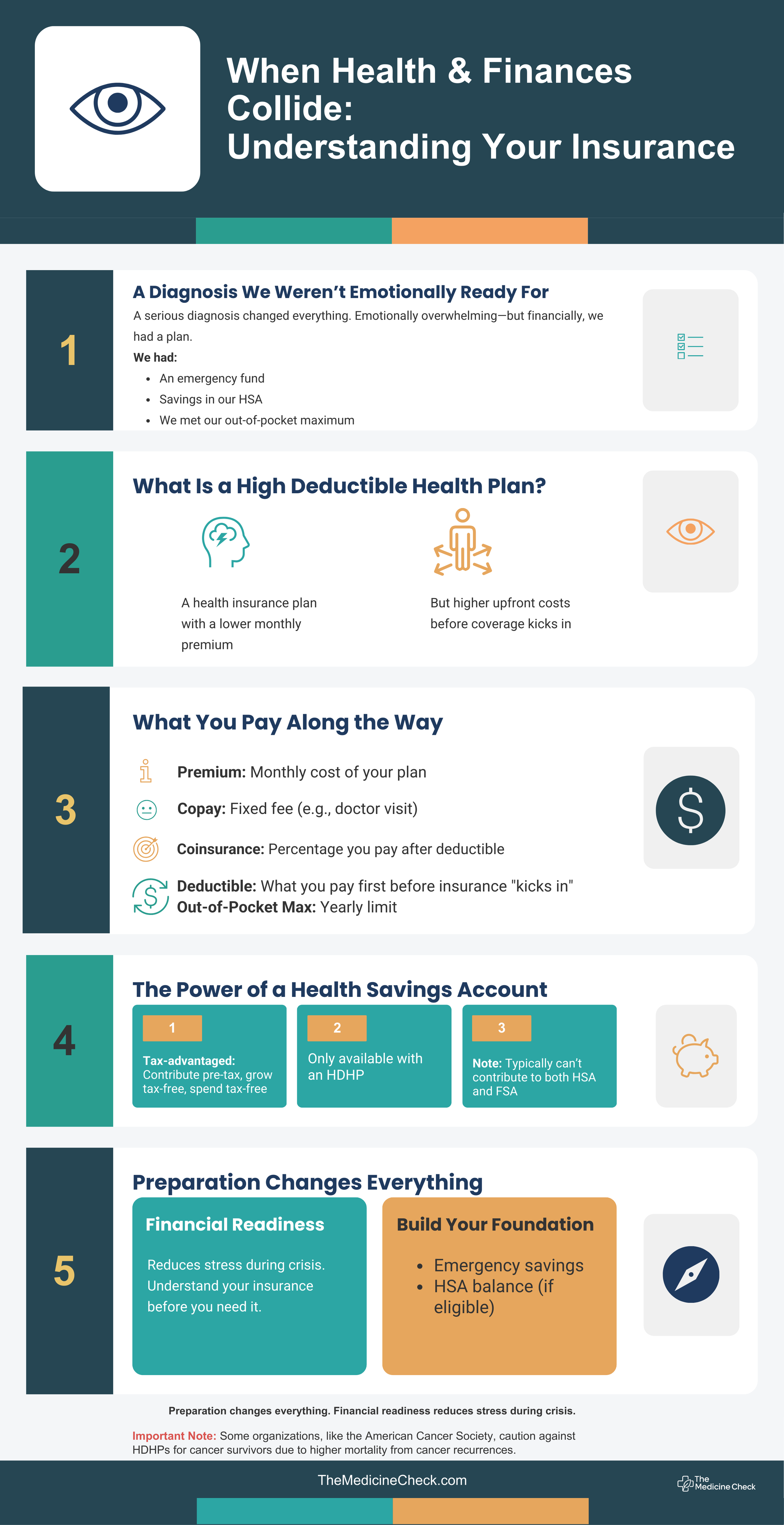
An infographic describing HSAs and the importance of financial preparation for medical costs.
Call to Action: Build Financial Resilience Before You Need It
If there is one takeaway from this experience, it is this:
Build an emergency fund to absorb unexpected healthcare costs
Understand your insurance structure before you need to use it
Simplify financial systems so they are manageable during stress
The path to health and wealth isn’t complicated — but it is hard. Preparation makes difficult moments more manageable.