

From Diagnosis to Recovery: What Surgery Teaches You About Healing
Summary
The time between diagnosis and surgery was a blur. Appointments, decisions, and waiting. Similar to many patients and families, this period was one of the most emotionally challenging in our journey. Surgery marked a turning point, yet recovery brought its own set of physical and psychological adjustments. Preparing for surgery and supporting recovery isn’t just about medical care; it’s about creating an environment that allows healing to happen.
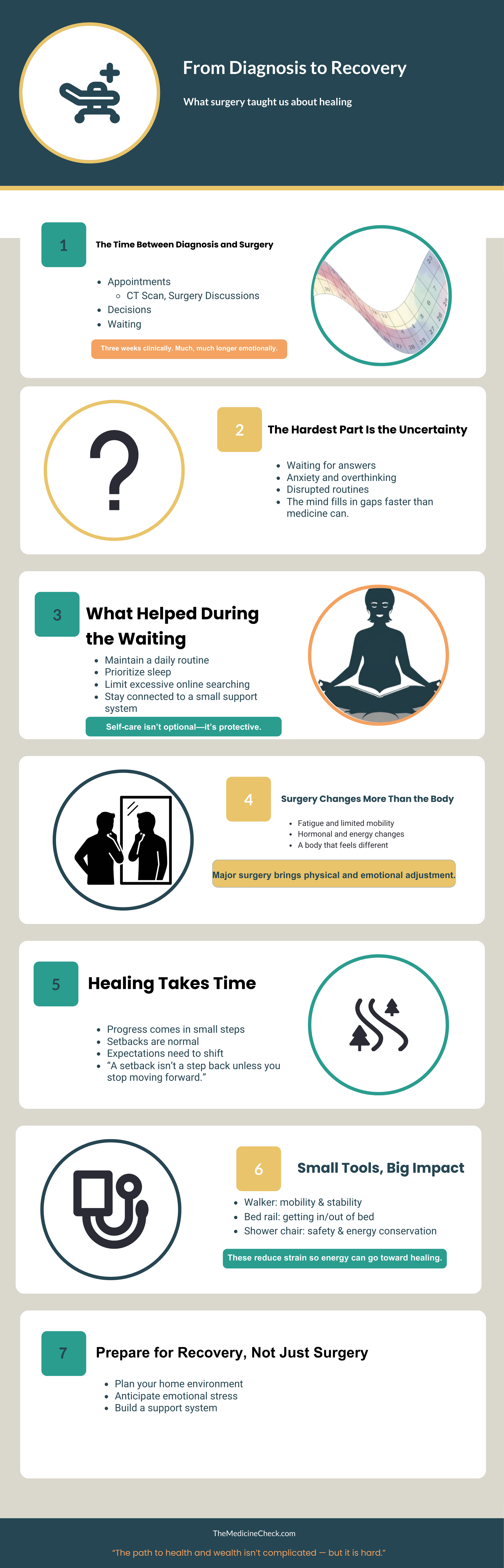
Infographic describing the challenges of the time between an initial diagnosis and recovery.
The “In-Between” Is Often the Hardest Part
From the moment an ovarian mass was discovered to the final diagnosis, about three weeks passed. Clinically, that timeline is not unusual. Emotionally, it felt much longer. Much much longer.
This “in-between” period, after something abnormal is found but before there is clarity, is filled with uncertainty. It’s a time when the mind fills in gaps faster than medicine can provide answers. Anxiety, difficulty concentrating, and disrupted routines are common, and they are a normal response to uncertainty. I am so grateful to our surgeon and her communication style of honesty, openness, and 100% complete supportiveness and empathy.
During this time, I learned that self-care is not optional; it’s protective. Simple practices like maintaining a daily routine, prioritizing sleep, limiting excessive online searching, and staying connected to a small support network can help stabilize what otherwise feels unpredictable.
Surgery Changes More Than the Body
Surgery provides answers and treatment, but it also represents a major physiological and emotional shift. Procedures like an exploratory laparotomy, where the abdominal cavity is open and exposed, and the resultant total abdominal hysterectomy with bilateral salpingo-oophorectomy (TAH-BSO), appendectomy, and omentectomy are significant operations that affect not only recovery time, but also how someone experiences their body afterward.
Fatigue, discomfort, and reduced mobility are expected early in recovery. Less often discussed is the adjustment to a body that feels different—temporarily or permanently. This can include changes in strength, energy, hormonal balance, and physical confidence.
Recovery is not linear. Progress often happens in small increments, and expectations may need to shift. Healing requires both physical recovery and psychological adaptation. And recovery doesn’t always happen in a positive direction. There are unexpected setbacks. It is a journey up a hill with constant effort to continue progressing with bumps that cause setbacks. But in the words of one of my favorite Coaches (Coach Bennett of Nike Run Club), a setback isn’t a step back until a choice is made to not take another step forward. Persistence, consistency, with good luck sprinkled in are key.
Small Practical Supports Make a Big Difference
One of the most helpful lessons we learned is that recovery is shaped by the environment you return to.
Simple tools made a meaningful difference:
A walker for early mobility and stability
A bed rail to assist with getting in and out of bed
A shower chair to reduce fall risk and conserve energy
These are small interventions, but they reduce strain, improve safety, and allow energy to be directed toward healing rather than basic tasks.
In medicine, we often focus on procedures and outcomes. In recovery, it’s the small, practical supports that make daily life manageable.
Prepare for Recovery, Not Just Surgery
If you or someone you love is preparing for surgery, consider:
Plan your environment ahead of time with simple mobility supports
Anticipate the emotional impact of waiting and recovery
Prioritize rest, routine, and support systems during uncertain periods
The path to health and wealth isn’t complicated — but it is hard. Preparation makes the hard moments more manageable.