

Policy Risk Is a Wealthspan Checkup Signal
How the 2026 Social Security and Medicare Trustees reports can help you review retirement income, health costs, and future flexibility without panic.
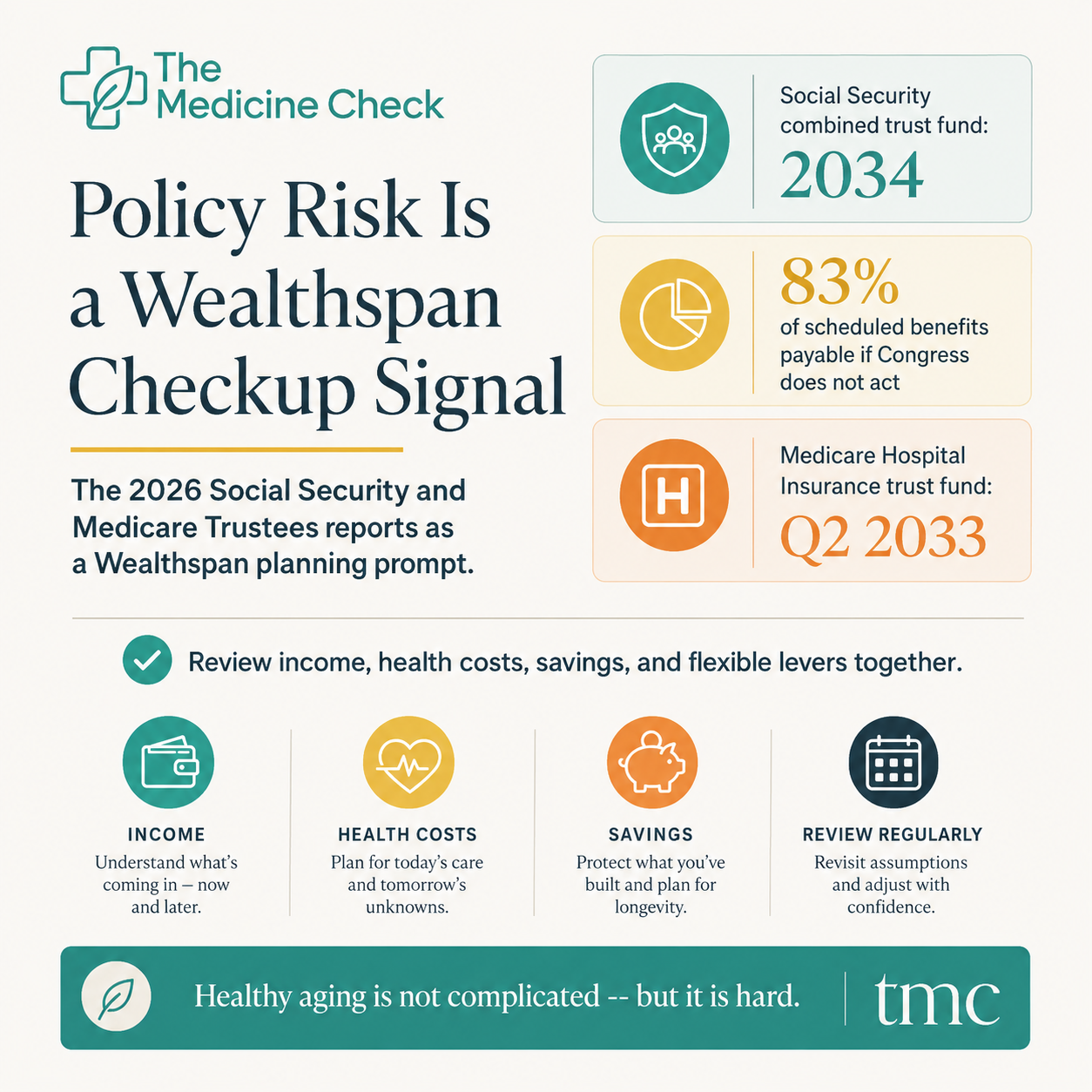
Infographic for The Medicine Check showing the 2026 Social Security and Medicare Trustees report dates, the 83% payable-benefits figure, and a four-part Wealthspan review of income, health costs, savings, and regular planning.
The retirement news worth turning into a checkup
The 2026 Social Security and Medicare Trustees’ reports, released June 9, are the kind of public-finance update that can sound abstract until it touches a household budget. Trust fund dates, actuarial deficits, and projected benefit percentages are policy language. Wealthspan translates them into a more practical question: how much flexibility will you still have if retirement income, health costs, or program rules do not unfold exactly as expected?
The answer is not to assume Social Security or Medicare are disappearing. They are not. The answer is also not to ignore the warning lights because the dates are several years away. For people building or living on a retirement plan, this is a useful midyear point to review income assumptions, savings behavior, health-care exposure, and the backup levers that preserve independence later in life.
Wealthspan is the financial capacity to age well. That includes the basics of saving and investing, but it also includes health-care affordability, insurance choices, work optionality, housing flexibility, emergency reserves, and the ability to make healthy decisions without every choice being forced by cash flow.
What the 2026 Trustees reports actually said
The Social Security trustees reported that the combined Old-Age and Survivors Insurance and Disability Insurance trust funds are projected to have enough dedicated revenue to pay full scheduled benefits until 2034. If Congress does not act before then, continuing income would be enough to pay 83% of scheduled benefits. The retirement and survivors trust fund by itself, known as OASI, is projected to be depleted in the fourth quarter of 2032, with 78% of scheduled benefits payable at that time.
The Medicare trustees reported a separate pressure point. The Hospital Insurance trust fund, which supports Medicare Part A hospital and post-acute benefits, is projected to pay full scheduled benefits until the second quarter of 2033. After that, continuing income would cover 89% of scheduled benefits. The trustees also noted that Medicare costs are expected to rise faster than workers’ earnings or the overall economy over time.
Those numbers are projections, not promises. They depend on assumptions about demographics, wages, health spending, productivity, immigration, law, and policy choices. But they are still useful because they identify the kind of uncertainty that belongs inside a retirement plan, not outside it.
Why this is a Wealthspan issue, not just a Washington issue
For households, the risk is not only that a future benefit could be lower than expected. The bigger risk is compression: higher health costs, modest savings, and less reliable income arriving at the same time. That compression can narrow choices about housing, caregiving, transportation, food, prescriptions, preventive care, and whether someone can keep working or retire on their own terms.
This is why the Trustees reports belong in the same conversation as retirement savings and health-care planning. Fidelity estimated that a 65-year-old retiring in 2025 could spend an average of $172,500 on health care and medical expenses throughout retirement, excluding long-term care. Fidelity also noted that one in five Americans had never considered health-care costs during retirement. That gap between expected care needs and actual planning is exactly where Wealthspan can weaken.
Center for Retirement Research at Boston College framed the 2026 Social Security report as a more realistic picture of the program's finances, while also emphasizing that reforms are doable if lawmakers act. That is an important balance for readers: policy risk is real, but fatalism is not a plan.
The evidence verdict
Evidence verdict: strong for the claim that Social Security and Medicare face financing pressure under current projections; moderate for household-level planning implications because the exact policy response is unknown.
The strongest evidence here comes from official Trustees reports and summaries, supported by reputable retirement-policy analysis and consumer-facing explainers. The main limitation is that no one knows what Congress will eventually do. Future changes could involve revenues, benefits, eligibility rules, provider payments, premiums, taxes, or some mix of policy levers. That uncertainty is the point. You should not treat the 2032, 2033, or 2034 dates as a personal forecast. You should treat them as information to make your own plan less fragile.
A practical Wealthspan review for the second half of 2026
The most useful response is a calm review, not a dramatic overhaul. Start with four areas:
Income assumptions: If Social Security is part of your future income plan, run a conservative scenario. What happens if benefits grow more slowly, taxes change, claiming assumptions shift, or a household loses one benefit after a spouse dies?
Health-cost exposure: Review premiums, deductibles, expected out-of-pocket costs, prescription costs, dental, vision, hearing, and long-term care exposure. Medicare is essential, but it is not a complete shield against medical costs.
Savings levers: For workers still saving, check whether contributions are on track for the year. The IRS increased the 2026 401(k), 403(b), governmental 457, and Thrift Savings Plan employee deferral limit to $24,500. Catch-up contributions for many workers age 50 and older can be as high as $8,000, and workers ages 60 through 63 may have an $11,250 catch-up limit if their plan allows it.
Health savings tools: For eligible people who are not enrolled in Medicare, HSAs may help prepare for current and future qualified medical expenses. Fidelity lists the 2026 HSA contribution limits as $4,400 for self-only coverage and $8,750 for family coverage, with an additional $1,000 catch-up contribution at age 55 and older.
None of these are one-size-fits-all instructions. The point is to know which levers exist, which ones apply, and which tradeoffs deserve a more careful conversation with a qualified financial, tax, benefits, or Medicare professional.
The question that makes this less abstract
A simple Wealthspan checkup question is this: if retirement income came in lower or health costs came in higher than expected, what would bend first?
Would savings contributions stop? Would emergency reserves shrink? Would a person delay care? Would they work longer than planned? Would housing become harder to maintain? Would adult children become the backup plan? Would a surviving spouse have enough monthly income?
Those are not cheerful questions, but they are useful ones. The earlier they are asked, the more options usually remain. A plan reviewed at 50, 55, 60, or 65 has more room for course corrections than a plan first tested by a crisis at 78.
What not to do with this news
Do not assume that Social Security will pay nothing. The trustees project reduced payable benefits if Congress does not act, not zero benefits.
Do not make abrupt investment, claiming, insurance, or tax decisions based on one headline. These are complex choices with long-term consequences.
Do not treat Medicare as a full health-cost plan. Premiums, cost sharing, prescription drugs, dental, vision, hearing, and long-term care can still matter a lot.
Do not wait for perfect certainty. Policy uncertainty is exactly why flexible planning matters.
The bottom line
The 2026 Trustees reports are not a reason to panic about aging in America. They are a reason to make retirement planning more honest.
A durable Wealthspan plan does not assume that every public program, market return, health outcome, or household expense will behave perfectly. It builds in review points. It protects cash flow. It makes health costs visible. It keeps savings and insurance decisions connected to the real goal: preserving independence, function, and choice over time.
Healthy aging is not complicated -- but it is hard. It gets easier when the retirement-income plan and the health-cost plan are reviewed together.
Keep Building Your Wealthspan
Estimate future medical costs with the Retirement Healthcare Spend Estimator.
Model savings decisions with the Retirement Savings Calculator.
Track both money and health trends in the Annual Wealthspan + Healthspan Checkup Tracker.
-
Social Security and Medicare Boards of Trustees. A Summary of the 2026 Annual Reports.
AARP. Social Security Report Projects Trust Fund Shortfall in 2034. Published June 9, 2026.
Internal Revenue Service. Retirement topics - Catch-up contributions. Updated May 7, 2026.
Fidelity. HSA contribution limits and eligibility rules for 2026 and 2027. Published June 5, 2026.
Fidelity Investments. 2025 Retiree Health Care Cost Estimate. Published July 30, 2025.