

Semaglutide and Aging Markers: What the New Study Really Shows
A new randomized-trial analysis found changes in biological aging markers, but it does not prove that semaglutide reverses aging or extends lifespan.
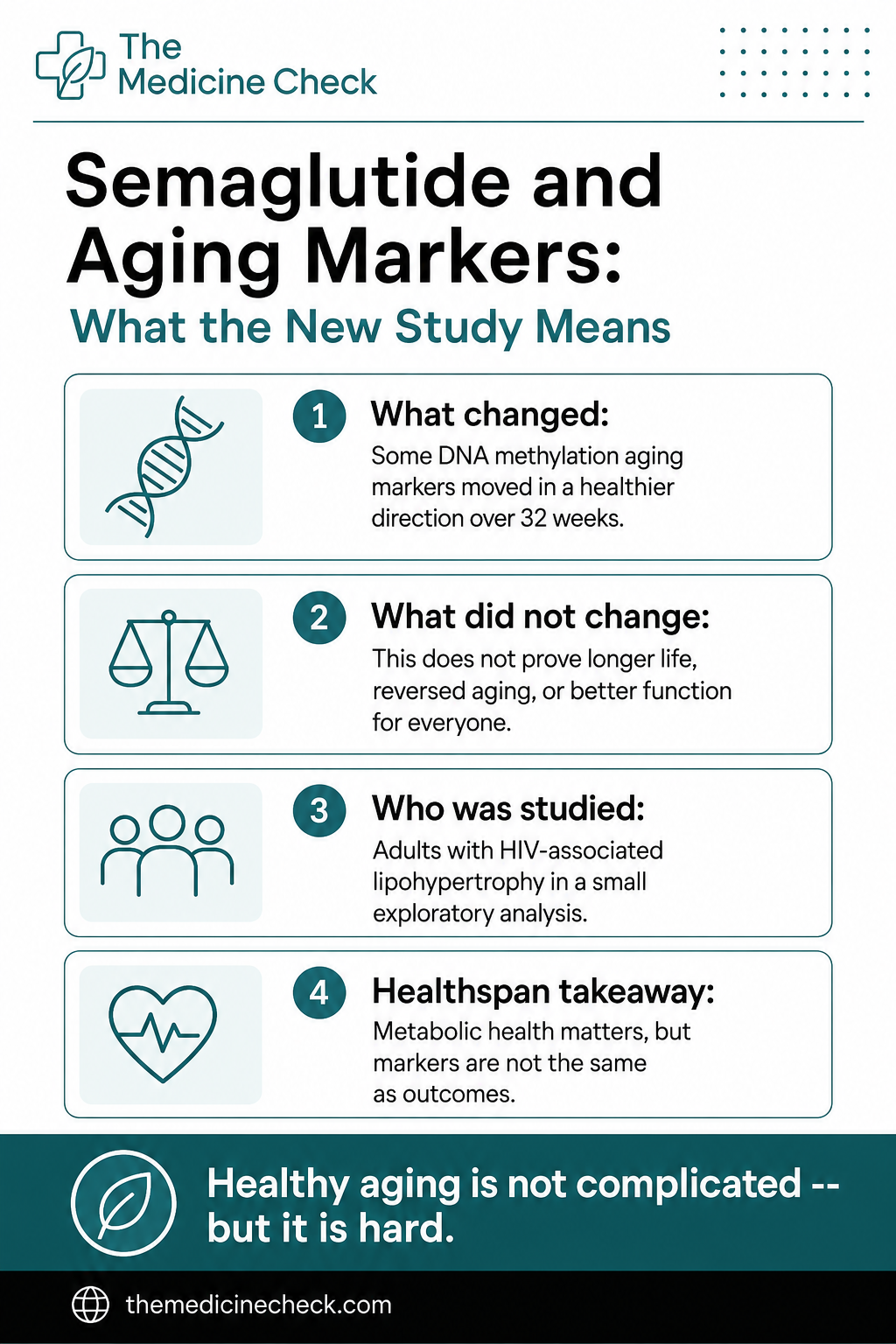
Alt text: Editorial infographic explaining that semaglutide shifted some DNA methylation aging markers in a small exploratory HIV-associated lipohypertrophy study, while emphasizing that markers are not the same as proven healthspan outcomes.
Semaglutide and Aging Markers: What the New Study Really Shows
A new study is getting attention because it connects semaglutide, the medication better known for diabetes and obesity treatment, with biological aging markers.
That is a big-sounding claim. It is also exactly the kind of claim that needs careful translation.
The short version: researchers found that semaglutide appeared to slow or improve several DNA methylation-based aging markers over 32 weeks in a small group of adults with HIV-associated lipohypertrophy. That is interesting because it came from a randomized, double-blind, placebo-controlled trial dataset.
But it does not prove that semaglutide reverses aging. It does not prove that people live longer. It does not prove better mobility, cognition, independence, or quality of life for the general population.
For healthspan, the useful lesson is not “take a drug to get younger.” The useful lesson is this: metabolic health and inflammation are deeply tied to aging biology, but biological markers are only helpful if we understand their limits.
What The Study Found
The new paper, published May 19, 2026, in Nature Communications, was a post hoc exploratory analysis of a 32-week phase 2b randomized trial. The participants were adults with HIV-associated lipohypertrophy, a condition involving abnormal abdominal fat accumulation that can occur in people living with HIV. In the epigenetic analysis, 45 participants received semaglutide and 39 received a placebo.
Researchers measured DNA methylation patterns in blood at the start of the study and again after 32 weeks. DNA methylation refers to chemical marks on DNA that help regulate gene activity. Some patterns are used to estimate “epigenetic age” or the pace of biological aging.
In adjusted analyses, semaglutide was associated with improvements across several second- and third-generation epigenetic clocks, including PhenoAge, GrimAge-related measures, OMICmAge, RetroAge, and DunedinPACE. The authors reported a 9% slower DunedinPACE measure and parallel reductions in systems-based aging measures linked to inflammation, brain, and heart aging.
That sounds powerful. But the most important line in the study may be the caveat: epigenetic aging was not the parent trial’s original primary endpoint. The original trial was designed mainly to study visceral fat and cardiometabolic outcomes, not aging itself.
Why This Is Worth Paying Attention To
This study is more meaningful than a typical longevity headline because it was based on randomized trial data, not only an observational association. Randomized trials reduce some forms of bias because participants are assigned to treatment or placebo rather than simply observed based on what they already chose or were prescribed.
It also fits a larger biological story. Excess visceral fat, insulin resistance, chronic inflammation, fatty liver disease, cardiovascular risk, and immune activation are all connected to how people age. Semaglutide and other GLP-1 receptor agonists can improve weight and cardiometabolic risk factors in selected patients, and researchers are now asking whether those effects may also show up in aging-related biomarkers.
A related npj (Nature Partner Journals) Aging pilot study, published April 21, 2026, also looked at semaglutide and epigenetic aging in 41 people with HIV and metabolic dysfunction-associated steatotic liver disease. That study was smaller, single-arm, and exploratory, but it found that some participants with improved aging-marker patterns also had greater liver fat reduction, and some marker changes were associated with gait-speed signals.
Again, that is not proof of longer life. But it is a clue worth studying.
The Caveats Matter
This is where the responsible interpretation begins.
First, the study population was narrow. These were adults with HIV-associated lipohypertrophy, not a broad sample of healthy adults, older adults, or people taking semaglutide for obesity or diabetes in routine care.
Second, the analysis was post hoc and exploratory. That means researchers examined aging markers after the original trial was designed, rather than making those markers the pre-specified main outcome from the beginning.
Third, the sample size was modest. The epigenetic analysis compared 45 people on semaglutide with 39 on placebo.
Fourth, the follow-up was short for an aging question: 32 weeks. That can detect changes in biomarkers, but it cannot tell us whether people will live longer, stay independent longer, avoid dementia, avoid frailty, or preserve mobility.
Fifth, epigenetic clocks are not the same as healthspan. They may help researchers study aging biology, but they are not a substitute for outcomes readers actually care about: strength, cognition, balance, energy, blood pressure, glucose control, cardiovascular events, hospitalizations, disability, and quality of life.
What Readers Should Not Take From This
This study should not be read as a reason to start semaglutide for “anti-aging.”
Semaglutide is a prescription medication with real benefits for appropriate patients and real tradeoffs. It can cause gastrointestinal side effects, may not be appropriate for everyone, and requires clinician guidance. For healthspan, medication decisions should be based on a person’s actual medical situation, not a biological-age headline.
It also should not be read as proof that a lower “biological age” score automatically means better aging in real life.
Markers can be useful, but function is the test that matters.
Can you climb stairs? Carry groceries? Maintain muscle? Recover from illness? Keep blood pressure and glucose in healthy ranges? Sleep well? Think clearly? Stay socially connected? Avoid preventable disability?
Those are healthspan outcomes.
The Practical Healthspan Takeaway
The best takeaway is not that one medication is an anti-aging shortcut. The better takeaway is that metabolic health is one of the central pillars of aging well.
For many people, that means paying attention to the basics that influence visceral fat, inflammation, insulin sensitivity, and long-term function:
waist and weight trends
blood pressure
A1C or fasting glucose
lipid markers
liver health when relevant
muscle and strength
daily movement
protein and overall nutrition quality
sleep and recovery
medication review with a clinician or pharmacist
Those markers are not glamorous, but they are measurable. They also connect directly to the Annual Wealthspan + Healthspan Checkup Tracker, which is useful because healthy aging is easier to improve when you can see what is changing over time.
Bottom Line
The new semaglutide study is scientifically interesting because it suggests that a metabolic medication may influence biological aging markers in a specific high-risk group.
But the evidence is still early for aging itself.
The safest summary is this: semaglutide may affect some aging-related biological signals, especially in people with metabolic stress and HIV-associated lipohypertrophy, but we do not yet know whether that translates into longer lifespan, better function, or broader healthspan benefits.
For now, the study belongs in the “promising but not proven” category.
Keep Building Your Healthspan
Track your yearly progress with the Annual Wealthspan + Healthspan Checkup Tracker.
If medications are part of the story, review your list with the Anticholinergic Burden Calculator.
Sources
Corley MJ, Dwaraka VB, Pang APS, et al. “Semaglutide slows epigenetic aging in a randomized trial of HIV-associated lipohypertrophy.” Nature Communications. Published May 19, 2026. https://www.nature.com/articles/s41467-026-72861-3
Medical Xpress / UC San Diego. “Popular GLP-1 drug may slow down biological aging, analysis indicates.” Published June 3, 2026. https://medicalxpress.com/news/2026-06-popular-glp-drug-biological-aging.html
Corley MJ, Pang APS, Kitch DW, et al. “Pilot study of epigenetic aging and treatment response to semaglutide in the SLIM LIVER study.” npj Aging. Published April 21, 2026. https://www.nature.com/articles/s41514-026-00383-9
Eckard AR, Wu Q, Sattar A, et al. “Once-weekly semaglutide in people with HIV-associated lipohypertrophy.” The Lancet Diabetes & Endocrinology. 2024;12:523-534. DOI: 10.1016/S2213-8587(24)00150-5