

The Retirement Health-Cost Is Not One Number
New retirement health-cost estimates from Milliman, EBRI, Fidelity, KFF, and Schwab point to a practical Wealthspan lesson: plan by cost bucket, not by one scary headline number.
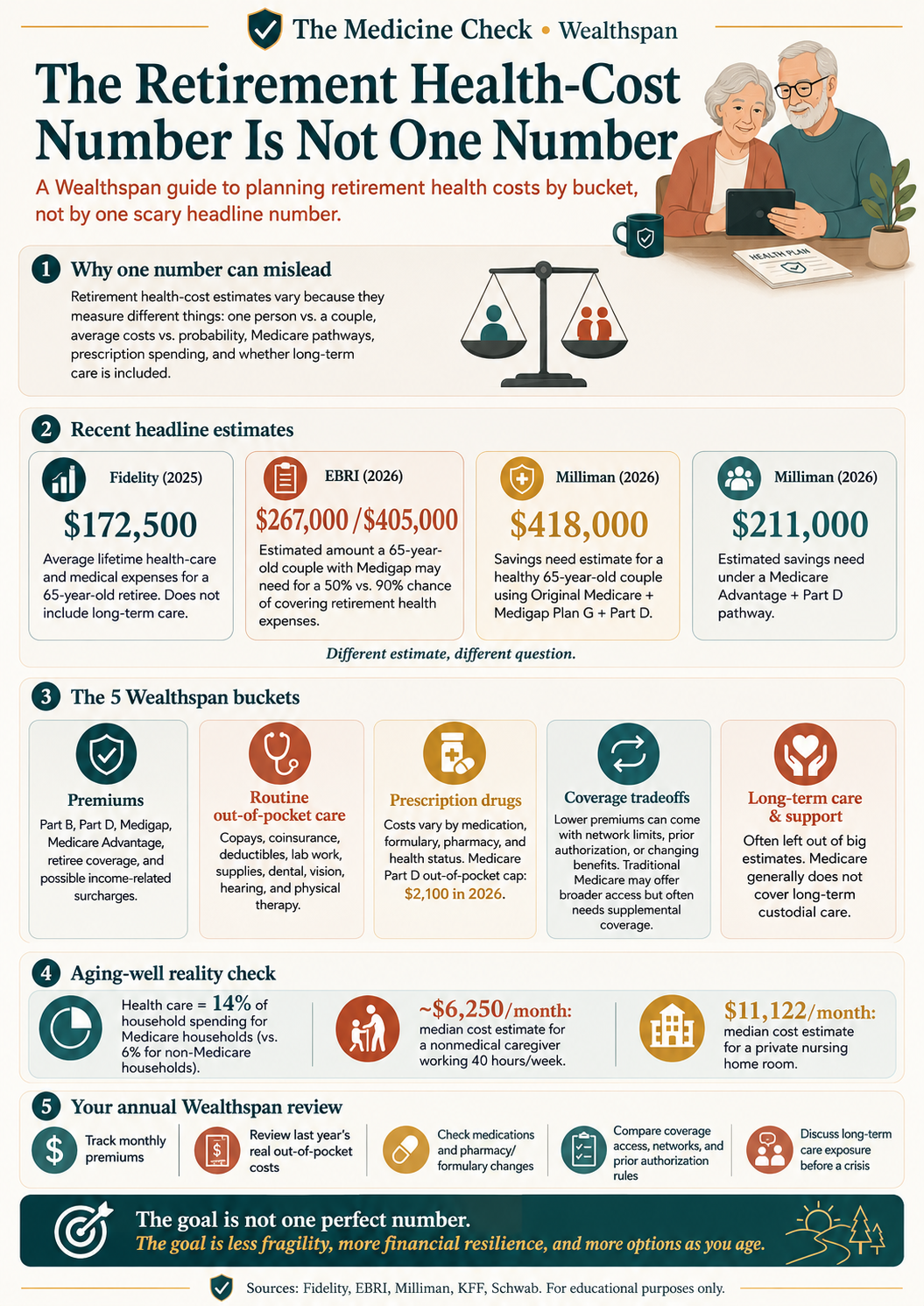
Why the big number can mislead
Retirement health-care costs are one of the places where people can get both too anxious and not prepared enough. The scary headline number is important, but it is rarely the whole planning story.
Milliman released its 2026 Retiree Health Cost Index in June, and the headline was attention-grabbing: a healthy 65-year-old couple retiring in 2026 may need about $418,000 in savings under Original Medicare with Medigap Plan G plus Part D coverage. Under a Medicare Advantage plus Part D pathway, Milliman estimated the savings need at about $211,000. Those are very different numbers, and neither one includes every possible aging-related expense.
That is the Wealthspan lesson. The question is not simply, "What is the number?" The better question is, "Which bucket am I planning for, and which risks are still outside the bucket?"
Wealthspan is the financial capacity to age with options, independence, and resilience. Health-care planning belongs in that conversation because a medical bill does not only affect a budget. It can affect medication access, timing of care, housing choices, caregiving decisions, and the ability to preserve savings for later-life needs.
What the recent estimates actually say
Recent retirement health-cost estimates point in the same direction, but they measure different things.
Fidelity estimated in July 2025 that a 65-year-old retiring that year could spend an average of $172,500 on health care and medical expenses throughout retirement. Fidelity’s estimate assumes Original Medicare Parts A and B plus Part D, and it includes premiums, copayments, and other out-of-pocket medical and prescription drug costs. It does not include long-term care.
EBRI’s March 2026 analysis used a simulation model and showed why probability matters. A 65-year-old couple enrolled in Medigap with average premiums would need an estimated $267,000 for a 50% chance of covering retirement health expenses and $405,000 for a 90% chance. EBRI also noted an extreme case in which a couple with particularly high prescription drug spending could need $469,000 for a 90% chance.
Milliman’s 2026 index used a different framework and found that a healthy 65-year-old male retiring in 2026 under Original Medicare plus Medigap Plan G plus Part D is projected to spend about $297,000 over retirement, while a female retiree is projected to spend about $340,000, partly because of longer expected life span. The same report estimated lower projected spending under Medicare Advantage plus Part D, but that lower spending comes with different tradeoffs.
KFF’s Medicare affordability work adds the lived-budget context. In 2023, Medicare beneficiaries spent an average of $6,459 out of pocket on health care. In 2024, health care accounted for 14% of total household spending for Medicare households, compared with 6% for non-Medicare households. KFF also reported that the standard annual Part B premium roughly doubled from 2015 to 2026.
The point is not that one estimate is right and the others are wrong. They are answering different questions. Some focus on one person, some on couples, some on savings needed today, some on lifetime spending, and some on specific coverage pathways.
The five buckets that matter most
Premiums. Medicare Part B, Part D, Medigap, Medicare Advantage supplemental premiums, employer retiree coverage, and income-related surcharges can all affect monthly cash flow. Premiums are predictable enough to track, but they can still rise over time.
Routine out-of-pocket care. Copays, coinsurance, deductibles, regular visits, lab work, supplies, dental care, vision care, hearing care, and physical therapy are not financial emergencies, but they are easy to underestimate because they arrive in pieces.
Prescription drugs. The Medicare Part D out-of-pocket cap offers meaningful protection against very high drug costs. KFF notes that the Part D cap is $2,100 in 2026. But prescription costs still vary by drug, formulary, pharmacy, subsidy eligibility, and health status.
Coverage design tradeoffs. Medicare Advantage plans often have lower premiums and an annual out-of-pocket limit for Medicare-covered Part A and Part B services. But KFF’s 2026 Medicare Advantage review also shows that networks, prior authorization, and changing supplemental benefits matter. Traditional Medicare offers broader provider access, but it has no out-of-pocket limit for covered Part A and Part B services unless paired with supplemental coverage such as Medigap.
Long-term care and support. This is the bucket many estimates and people leave out. Medicare does not cover long-term custodial care. Schwab recently highlighted that 2026 median costs are estimated at nearly $6,250 per month for a nonmedical caregiver working 40 hours per week and $11,122 per month for a private room in a nursing home. Those numbers are not a prediction for every household, but they show why long-term care planning should not be quietly folded into ordinary Medicare planning.
Why this is a healthy-aging issue, not just a finance issue
Healthspan depends on consistency. Blood pressure control, diabetes care, mobility work, fall prevention, medication adherence, dental care, vision correction, hearing support, and timely follow-up are all easier when the financial side is visible before it becomes urgent.
Cost pressure can change behavior. People may delay appointments, split pills, skip refills, avoid dental work, decline home support, or wait too long to address a mobility problem. A Wealthspan plan cannot guarantee better health outcomes, and budgeting is not a medical treatment. But financial resilience can protect the conditions that make it easier to sustain healthy decisions.
This is also why one large estimate can be emotionally unhelpful. A $400,000 number can make people shut down. A bucketed plan gives the mind something to do: track premiums, review prescriptions, compare coverage tradeoffs, build cash reserves, and discuss long-term care exposure before a crisis.
A practical annual review
Once a year, preferably before Medicare open enrollment or before a broader retirement-plan review, write down the five health-cost buckets and ask what changed.
For premiums, list the monthly amount for health coverage, drug coverage, and supplemental coverage. For routine care, estimate what the last 12 months actually cost. For prescriptions, review current drugs, dosage, pharmacy costs, formulary status, and whether any lower-cost clinically appropriate alternatives should be discussed with a clinician or pharmacist. For coverage design, check networks, prior authorization rules, out-of-pocket limits, dental and vision details, and travel or second-opinion needs. For long-term care, discuss where help would come from if bathing, dressing, meals, transportation, medication routines, or home safety became difficult.
This is also a good place to use The Medicine Check Annual Wealthspan + Healthspan Checkup Tracker. Health costs should sit beside blood pressure, strength, sleep, medications, savings, debt, and retirement planning because those measures are connected in real life.
The goal is not to pick the cheapest plan or chase a perfect estimate. The goal is to reduce fragility. A plan that looks inexpensive but makes needed care hard to access may not support healthy aging. A plan with broader access but higher premiums may strain cash flow. The right question is not universal; it depends on health needs, providers, medications, income, savings, risk tolerance, geography, and family support.
The bottom line
Retirement health-care planning should not be reduced to one number. The recent estimates from Milliman, EBRI, Fidelity, KFF, and Schwab are useful because they show the scale of the issue. But the practical Wealthspan move is to break the issue apart.
Plan for premiums. Plan for routine out-of-pocket care. Plan for prescriptions. Understand the coverage tradeoffs. Treat long-term care as its own category.
That kind of planning does not remove uncertainty. It makes uncertainty more visible. And visibility is one of the quiet ways financial resilience supports independence, healthspan, and aging well.
Keep Building Your Wealthspan
Estimate future medical costs with the Retirement Healthcare Spend Estimator.
Model savings decisions with the Retirement Savings Calculator.
Track both money and health trends in the Annual Wealthspan + Healthspan Checkup Tracker.