
A New Cholesterol Pill Is a Healthspan Prevention Story
The FDA just approved the first oral PCSK9 inhibitor. The news matters because LDL cholesterol is one of the most measurable long-term prevention targets, but the pill itself still needs direct outcomes data.
Why this week's cholesterol news matters for healthy aging
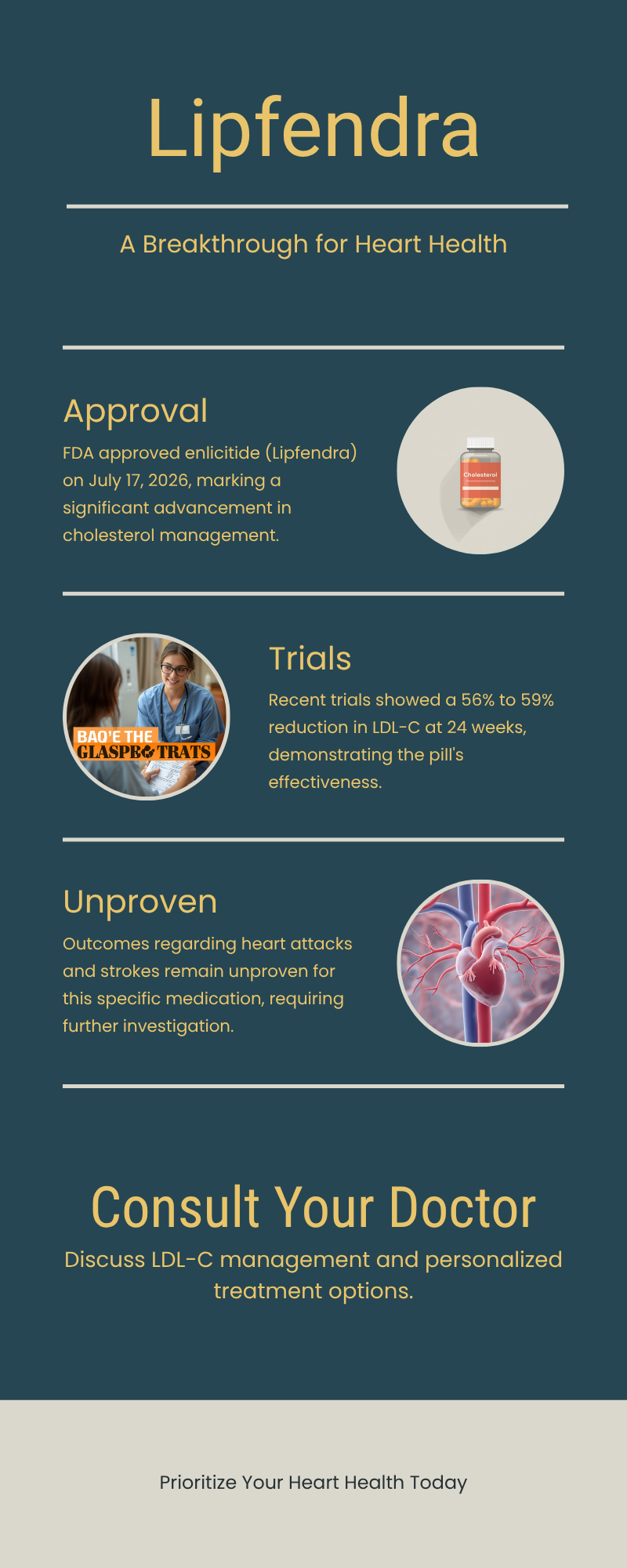
The most important evidence-backed health development this week was not a new longevity supplement, a biohacking claim, or a dramatic promise about aging. It was quieter and more practical: on July 17, 2026, the FDA approved Lipfendra, the brand name for enlicitide, as the first oral PCSK9 inhibitor for adults with high LDL cholesterol.
That may sound narrow. It is not. Cardiovascular disease remains one of the main ways healthspan is lost: heart attacks, strokes, procedures, heart failure, medication burden, recovery time, and loss of confidence can all shrink the years a person spends functioning independently. LDL cholesterol is one of the most measurable and treatable risk factors in that chain.
The healthspan takeaway is not that everyone needs a new cholesterol pill. The takeaway is that cardiovascular prevention keeps moving toward more individualized, measurable risk reduction. For some adults whose LDL cholesterol remains above goal despite lifestyle measures and standard therapy, an oral PCSK9 option could eventually make intensive LDL lowering easier to discuss and, for some, easier to sustain.
What the FDA approved
The FDA approved enlicitide as an adjunct to diet and exercise to reduce LDL-C in adults with hypercholesterolemia, including adults with heterozygous familial hypercholesterolemia, an inherited condition that can cause lifelong high LDL cholesterol.
PCSK9 inhibitors are not new as a treatment class. Until now, however, available PCSK9-targeting therapies have been injectable. Enlicitide is different because it is taken as a once-daily oral tablet.
The approval was based on two randomized, double-blind, placebo-controlled trials involving 3,207 adults with high cholesterol who were receiving maximally tolerated statin therapy. In the broader trial of adults with established atherosclerotic cardiovascular disease or high risk for it, LDL-C fell by an average of 56% at 24 weeks compared with placebo. In the familial hypercholesterolemia trial, LDL-C fell by an average of 59% at 24 weeks compared with placebo.
The FDA also reported that adverse-reaction discontinuation rates were comparable between enlicitide and placebo groups across the two trials. In the familial hypercholesterolemia trial, diarrhea and dizziness were the most common adverse reactions reported more often with enlicitide than placebo.
The evidence verdict
Evidence verdict: strong for LDL cholesterol lowering; not yet complete for hard cardiovascular outcomes with this specific pill.
That distinction is important. LDL-C is not a trivial lab number. Decades of evidence support LDL cholesterol as a causal and modifiable contributor to atherosclerotic cardiovascular disease, and current ACC/AHA guidance continues to emphasize lower LDL-C goals for people at higher cardiovascular risk.
Prior injectable PCSK9 inhibitors have gone beyond lowering LDL and have shown reductions in cardiovascular events in major outcomes trials. Evolocumab reduced cardiovascular events in the FOURIER trial among people with established cardiovascular disease. Alirocumab reduced ischemic events after acute coronary syndrome in ODYSSEY OUTCOMES.
But enlicitide itself was approved on LDL-lowering and safety data, not because a completed outcomes trial has already shown fewer heart attacks, strokes, or cardiovascular deaths. That trial evidence will likely come later. For now, the honest interpretation is promising but specific: this pill lowers LDL substantially in randomized trials, and it uses a pathway with strong biological and clinical precedent, but direct outcome proof for the pill is still pending.
Why this is a healthspan story, not just a cholesterol story
Healthspan is about preserving function, independence, cognition, mobility, and quality of life over time. Heart and vascular disease can threaten all of that.
A nonfatal heart attack can still mean hospitalization, new medications, cardiac rehabilitation, fatigue, anxiety, reduced exercise tolerance, and a changed sense of what the body can safely do. A stroke can alter speech, walking, swallowing, vision, cognition, or independence overnight. Even when people survive cardiovascular events, their healthspan can narrow.
That is why prevention is not only about avoiding death. It is about reducing the likelihood of events that can make aging harder.
The practical value of this approval is that it adds another possible tool to a prevention conversation that should already include lifestyle habits, blood pressure, diabetes risk, smoking status, family history, sleep, weight, physical activity, medication tolerance, cost, access, and personal risk level.
What readers should not misunderstand
This approval should not be read as a reason to stop a statin, skip lifestyle work, or assume the newest option is automatically the best option.
Statins remain foundational for many people because they are well studied, widely available, and proven to reduce cardiovascular events in appropriate patients. Ezetimibe, bempedoic acid, injectable PCSK9 monoclonal antibodies, inclisiran, and other therapies may also fit different situations. The right choice depends on baseline risk, LDL-C level, prior cardiovascular history, family history, other medical conditions, side effects, drug interactions, pregnancy considerations, insurance coverage, and patient preference.
It is also worth remembering that a pill can make treatment feel simpler, but once-daily therapy still depends on adherence. A medication only protects future health if it is taken correctly, tolerated, affordable, and monitored over time.
A practical cholesterol check-in
The most useful response for readers is not to ask, "Should I take this new drug?" The better question is, "Do I know my cardiovascular prevention plan?"
A reasonable annual check-in might include these questions:
Do I know my most recent LDL-C, non-HDL-C, triglycerides, blood pressure, A1C or glucose status, and smoking status?
Has my clinician estimated my 10-year and longer-term cardiovascular risk using current tools and my actual history?
Do I have risk enhancers that change the conversation, such as premature family history, chronic kidney disease, diabetes, inflammatory disease, early menopause, pregnancy-related complications, or high lipoprotein(a)?
If I already have cardiovascular disease, do I know my LDL-C goal and whether my current plan is getting me there?
If medication is recommended, do I understand the expected benefit, common side effects, cost, monitoring plan, and what to do if I cannot tolerate it?
Am I still doing the boring-but-powerful work: regular physical activity, strength training, sleep, blood pressure control, not smoking, nutritious eating patterns, and medication adherence?
The bottom line
The FDA approval of the first oral PCSK9 inhibitor is meaningful because it may expand the practical options for lowering LDL cholesterol in adults who need additional risk reduction. It is especially relevant in a prevention era where clinicians are increasingly trying to match LDL goals to a person's actual cardiovascular risk.
But the evidence should be kept in proportion. Enlicitide has strong randomized trial evidence for lowering LDL-C. It has not yet completed direct evidence showing that this specific pill reduces heart attacks, strokes, or death. That is the line between useful progress and overstatement.
My takeaway: cholesterol prevention is not about chasing a perfect number for its own sake. It is about protecting the future body you want to keep using. LDL-C is one of the few healthspan risk markers that can be measured, revisited, and treated with a growing set of tools. This approval makes the toolbox larger. The next step is making sure the toolbox is used thoughtfully.
Keep Building Your Healthspan
Track your yearly progress with the Annual Wealthspan + Healthspan Checkup Tracker.
If medications are part of the story, review your list with the Anticholinergic Burden Calculator.
-
U.S. Food and Drug Administration. FDA Approves First Oral PCSK9 Inhibitor to Lower LDL Cholesterol in Adults with High Cholesterol. Published July 17, 2026. https://www.fda.gov/news-events/press-announcements/fda-approves-first-oral-pcsk9-inhibitor-lower-ldl-cholesterol-adults-high-cholesterol
Navar AM, Mikhailova E, Catapano AL, et al. A Placebo-Controlled Trial of the Oral PCSK9 Inhibitor Enlicitide. New England Journal of Medicine. 2026;394:529-539. doi:10.1056/NEJMoa2511002 https://www.nejm.org/doi/full/10.1056/NEJMoa2511002
Ballantyne CM, Gellis L, Tardif JC, et al. Efficacy and Safety of Oral PCSK9 Inhibitor Enlicitide in Adults With Heterozygous Familial Hypercholesterolemia: A Randomized Clinical Trial. JAMA. 2026;335(2):129-139. doi:10.1001/jama.2025.20620 https://jamanetwork.com/journals/jama/fullarticle/2841258
American Heart Association. ACC/AHA Issue Updated Guideline for Managing Lipids, Cholesterol. Published March 13, 2026. https://newsroom.heart.org/news/accaha-issue-updated-guideline-for-managing-lipids-cholesterol
Centers for Disease Control and Prevention. Heart Disease Facts. Updated October 24, 2024. https://www.cdc.gov/heart-disease/data-research/facts-stats/index.html
Sabatine MS, Giugliano RP, Keech AC, et al. Evolocumab and Clinical Outcomes in Patients with Cardiovascular Disease. New England Journal of Medicine. 2017;376:1713-1722. doi:10.1056/NEJMoa1615664 https://www.nejm.org/doi/full/10.1056/NEJMoa1615664
Schwartz GG, Steg PG, Szarek M, et al. Alirocumab and Cardiovascular Outcomes after Acute Coronary Syndrome. New England Journal of Medicine. 2018;379:2097-2107. doi:10.1056/NEJMoa1801174 https://www.nejm.org/doi/full/10.1056/NEJMoa1801174
ClinicalTrials.gov. Enlicitide Decanoate Cardiovascular Outcomes Study (CORALreef Outcomes), NCT06008756. https://clinicaltrials.gov/study/NCT06008756