
Financial Education Is a Wealthspan Tool
A new EBRI issue brief suggests workplace financial education is linked with stronger financial capability. The practical question is whether workers are using those benefits before retirement decisions become urgent.
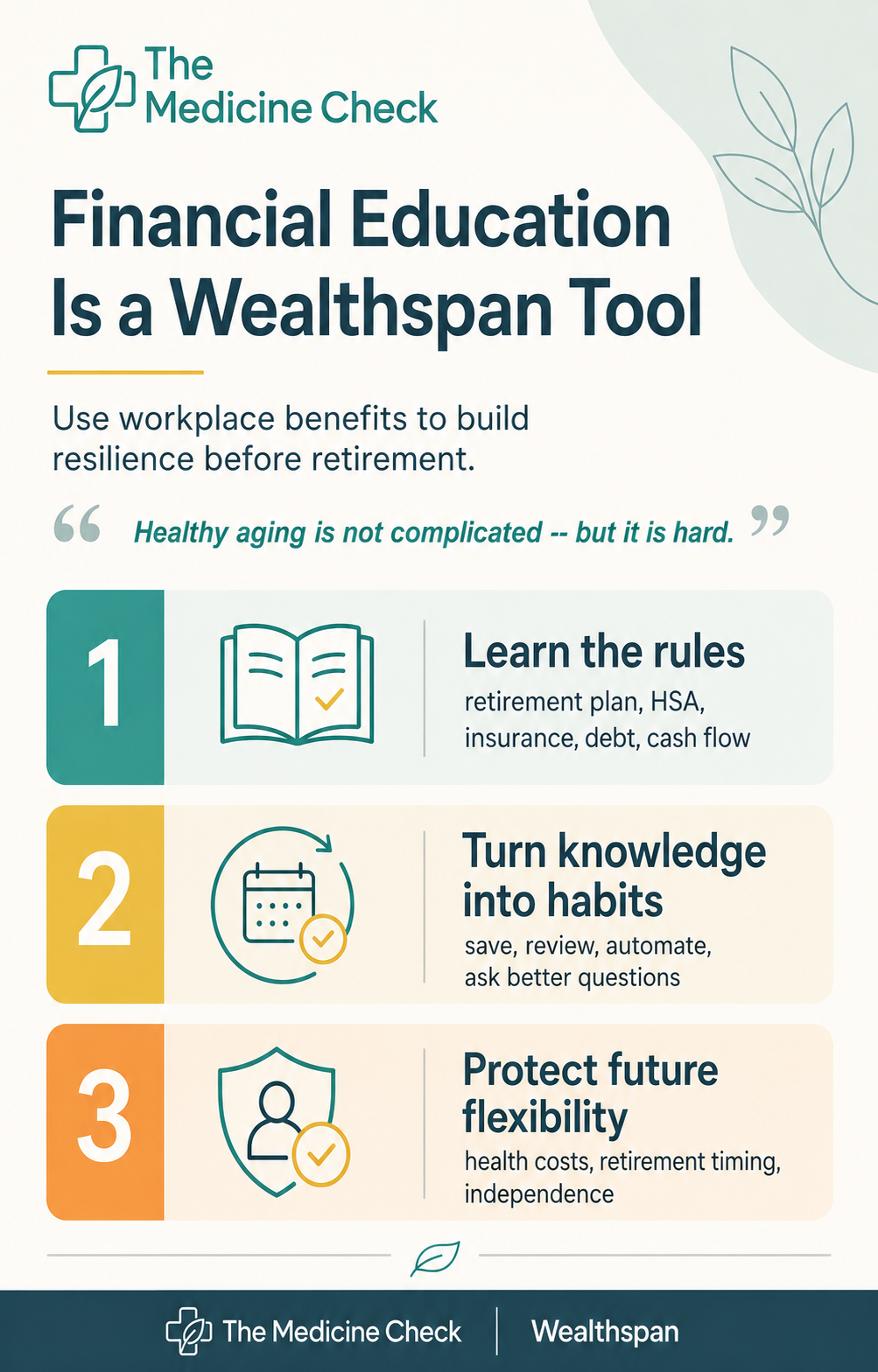
Financial education is not just a money topic. When people think about aging well, they often think about blood pressure, walking speed, sleep, strength, medications, and prevention. A durable healthy-aging plan also depends on whether a person understands the financial systems that support care, work flexibility, retirement timing, and independence.
That is why a new Employee Benefit Research Institute (EBRI) issue brief, published July 7, 2026, is a strong Wealthspan topic this week. EBRI examined the relationship between workplace-based financial education and financial capability using FINRA Investor Education Foundation National Financial Capability Study data, supplemented by EBRI workplace wellness survey data. The findings were not a randomized trial. They do not prove that any one workplace program causes better outcomes. But they point to something practical: workers who had participated in workplace financial education tended to report stronger financial knowledge and stronger markers of financial capability.
For Wealthspan, that is important because financial capability is one of the key skills behind aging with options. It helps people understand retirement plans, health savings accounts, insurance tradeoffs, debt, cash flow, taxes, beneficiary choices, and the cost of health care before those decisions become urgent.
What the new EBRI brief found
EBRI's July 7 issue brief found that participation in workplace-based financial education was associated with higher self-rated financial knowledge and better performance on a five-question financial knowledge assessment. Participants also showed stronger markers of financial capability. The practical differences were noticeable. EBRI reported that participants were more likely than nonparticipants to say they spent less than they earned, were satisfied with their current personal finances, and felt confident they could achieve a financial goal. Those relationships remained positive after controlling for household income, educational attainment, and other demographic factors.
At the same time, the access pattern deserves attention. Participation was concentrated among higher-income workers. More than half of the participants had household incomes over $150,000, and workers with higher education levels were more likely to report participation. In plain language, people who may already have more financial slack appear more likely to use the programs.
That is the main caveat. Workplace financial education may be useful, but it is not automatically reaching everyone who could benefit from it.
Why this belongs in a Wealthspan plan
Wealthspan is the financial capacity to age well. It is not simply having a large account balance. It is the ability to preserve options, absorb shocks, pay for care, avoid brittle decisions, and support independence across a longer life. Financial education connects to that because many late-career and retirement decisions are interconnected. A person deciding when to retire may also need to understand employer health coverage, the bridge to Medicare, Social Security timing, retirement withdrawals, debt, housing costs, long-term care exposure, and whether an HSA can help prepare for future medical expenses.
Fidelity's 2026 planning guidance makes the same broad point in practical terms: review goals, net worth, income, spending, long-term saving, asset allocation, insurance, and estate documents as part of a financial plan. Fidelity also estimates that a 65-year-old retiring in 2025 may need $172,500 in after-tax savings for health care expenses in retirement, depending on individual circumstances. That estimate is not a target for every household, but it is a reminder that health costs belong in the planning conversation.
EBRI's 2026 Retirement Confidence Survey adds the emotional context. Only 64% of Americans said they felt confident they would have enough money to live comfortably throughout retirement, down from the prior year. Inflation, debt, health care costs, housing costs, and concern about Social Security and Medicare all weighed on confidence.
In that environment, financial education is not about becoming a market expert. It is about reducing confusion before confusion becomes costly.
What financial capability looks like in real life
The Consumer Financial Protection Bureau defines financial well-being as having control over day-to-day and month-to-month finances, being able to absorb a financial shock, being on track for financial goals, and having the freedom to make choices that allow life enjoyment. That definition fits Wealthspan well. A person with stronger financial capability may be better prepared to ask questions such as:
- Am I saving enough to get the full employer match if one is available?
- Do I understand the difference between my pretax, Roth, taxable, and HSA options?
- Do I know what my health plan actually covers, including deductibles, networks, and out-of-pocket exposure?
- Have I reviewed beneficiaries, disability coverage, life insurance, and estate documents?
- Do I have cash reserves for health costs, home repairs, caregiving travel, or an income gap?
- If I want to retire before Medicare, have I estimated the coverage bridge?
Those are not one-time questions. They are review questions. The value of education is not only learning a concept once. It is building a habit of checking the right levers before a decision locks in.
Evidence verdict:
Moderate for the claim that workplace financial education is associated with stronger financial knowledge and capability markers, and limited for any causal claim about long-term retirement or health outcomes.
The EBRI brief is useful because it draws on large survey data and focuses on practical measures such as spending less than income, satisfaction with finances, goal confidence, and financial knowledge. But it is still observational. Workers who participate in financial education may differ from nonparticipants in motivation, employer quality, benefit access, income stability, schedule flexibility, or prior financial confidence.
So the safe takeaway is not "a seminar will fix retirement readiness." The safer takeaway is this: workplace financial education may be one useful tool, especially when paired with good plan design, automatic savings features, clear benefit communication, and regular personal check-ins.
Vanguard's 2026 How America Saves report supports that broader plan-design point. Vanguard reported record participation among eligible employees in its defined contribution data and highlighted the role of automatic enrollment, target-date funds, and professionally managed allocations. Education matters, but systems matter too.
A practical Wealthspan check-in for this week
If you have access to workplace financial education, benefits webinars, one-on-one sessions, retirement-plan tools, HSA education, or financial wellness resources, this is a good week to use one. Not because it will answer every question, but because it can reveal what you do not yet understand.
A simple check-in can start with five moves:
Review your benefits portal. Look for retirement-plan education, HSA guidance, insurance explainers, beneficiary tools, and planning calculators.
Choose one decision you keep avoiding. Examples: contribution rate, old 401(k), HSA use, disability insurance, emergency fund, estate documents, or health-plan tradeoffs.
Ask one better question. Instead of "Am I okay?" ask "What would break my plan if I had to retire three years earlier than expected?"
Turn the answer into a habit. Automate a contribution, schedule an annual review, update beneficiaries, or set a calendar reminder for open enrollment.
Connect money to function. Ask how the decision protects future care access, housing stability, work flexibility, or independence.
The bottom line
Financial education is not a cure-all. It cannot erase high prices, unequal benefit access, medical costs, debt, caregiving strain, or uncertainty around retirement policy. But it can make the system less opaque. The more clearly a person understands benefits, cash flow, savings options, insurance tradeoffs, and future health costs, the more room they may have to make calm decisions before a crisis forces the issue.
Keep Building Your Wealthspan
- Estimate future medical costs with the Retirement Healthcare Spend Estimator.
- Model savings decisions with the Retirement Savings Calculator.
- Track both money and health trends in the Annual Wealthspan + Healthspan Checkup Tracker.
-
EBRI. From the Break Room to the Bank: The Relationship Between Workplace-Based Financial Education and Financial Capability. Published July 7, 2026.
EBRI and Greenwald Research. 2026 Retirement Confidence Survey Finds Americans Less Confident About Retirement as Worries Grow Over Social Security, Medicare and Rising Costs. Published April 24, 2026.
FINRA Investor Education Foundation. FINRA Foundation Releases Sixth Wave of the National Financial Capability Study. Published July 16, 2025.
Consumer Financial Protection Bureau. Financial well-being resources. Page last modified June 8, 2026.
Fidelity. 5 steps to power up your finances. Accessed July 12, 2026.
Fidelity. How to plan for rising health care costs. Accessed July 12, 2026.
Vanguard. How America Saves 2026: 25th Edition. Published 2026.