
Walking Speed Is a Healthspan Signal, Not Just a Fitness Stat
New research on "super movers" adds to the case that how we move in older adulthood can reflect brain health, independence, and resilience.
The caveat: gait speed is a marker, not a magic switch.
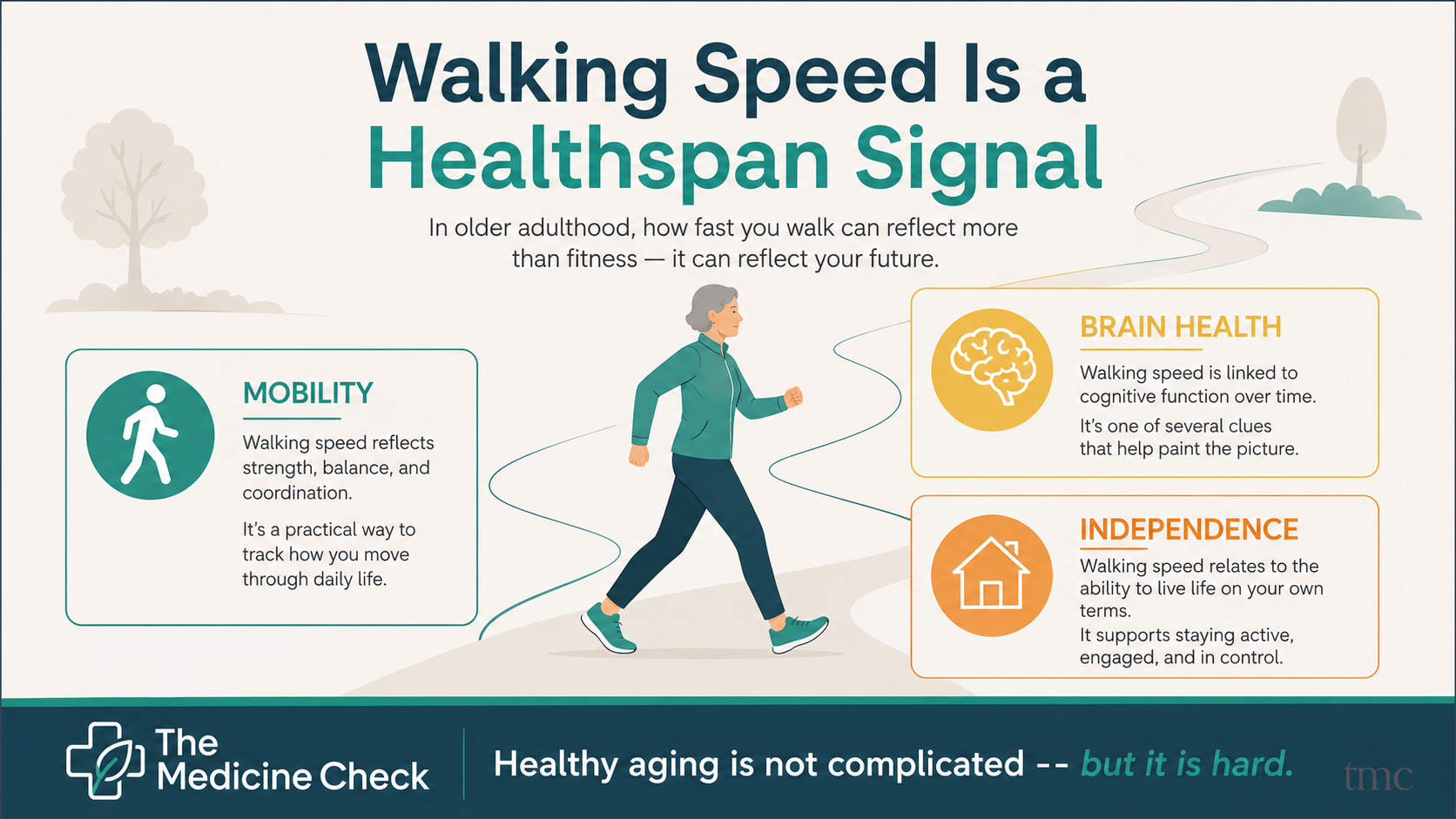
Most people think of walking speed as a fitness detail. Researchers increasingly see it as something bigger: a simple window into how the brain, heart, muscles, balance system, and daily function are working together. That makes gait speed one of the most practical healthspan signals we have.
A new paper in Neurology focused on "super movers," adults age 80 and older whose usual walking speed is unusually fast for their age. The study compared these faster walkers with age-norm peers and found that super movers had better cognitive aging patterns, including a lower risk of cognitive impairment over follow-up.
That does not mean walking faster automatically prevents dementia. It does mean that preserving mobility may be deeply connected to preserving independence, cognition, and resilience later in life.
What The New Study Looked At
The new Neurology study, "Cognitive Aging and Brain Health: A Comparison of Super Movers vs Nonsuper Movers," examined adults 80 and older and compared people with exceptionally fast walking speed against those with more typical or slower gait speed. The central finding was straightforward: older adults who maintained unusually fast usual walking speed appeared to have better cognitive outcomes over time than nonsuper movers.
This builds on a 2025 Journals of Gerontology: Series A study that introduced the "super mover" concept across 15 aging cohorts in 24 countries. In that earlier analysis, super movers were adults 80 and older who walked at speeds comparable to adults about 30 years younger. They made up a small share of older adults, roughly 5% to 11% depending on the cohort, and tended to have lower disease burden, healthier lifestyle patterns, younger biological aging measures in smaller subsamples, and lower mortality risk than their age peers.
In plain English: the people who moved unusually well in their 80s also tended to be doing better across several other aging-related measures.
Why Walking Speed Matters For Healthspan
Walking is not just a leg exercise. Normal walking requires coordination among multiple systems: muscle strength, balance, vision, joint health, cardiovascular capacity, nerve function, mood, attention, and executive function. That is why gait speed has long been called a kind of "vital sign" in aging research. When walking slows, it may reflect more than deconditioning. It can also signal illness burden, frailty, pain, fear of falling, neurologic change, or reduced reserve.
For healthspan, this matters because the goal is not simply to live longer. The goal is to preserve function: getting around, managing daily life, staying socially engaged, recovering from illness, and maintaining independence. Walking speed is useful because it is practical. It does not require expensive imaging, lab work, or a complicated device. It can be observed, tracked, and discussed in ordinary care settings.
The Brain-Health Connection
The new super mover research fits into a broader evidence base linking physical activity, vascular health, and cognitive aging.
The 2024 Lancet Commission on dementia prevention estimated that a meaningful share of dementia risk is tied to modifiable factors across life, including physical inactivity, cardiovascular risk, hearing loss, vision loss, smoking, depression, social isolation, diabetes, and high LDL cholesterol. The point is not that dementia is always preventable. It is that brain aging is influenced by many health and lifestyle factors, especially those that affect vascular health, sensory input, activity, and resilience.
The CDC's older-adult activity guidance also emphasizes a mix of aerobic activity, strength training, and balance work. For adults 65 and older, CDC recommends at least 150 minutes per week of moderate-intensity aerobic activity, two days of muscle-strengthening activity, and balance activities. Walking alone is useful, but healthy mobility also depends on strength, balance, coordination, and confidence.
What This Study Does Not Prove
This is where the caveat matters:
The super mover findings do not prove that telling an older adult to walk faster will prevent cognitive decline. People who walk faster at age 80 may have been healthier for decades. They may have fewer chronic diseases, better cardiovascular health, better hearing or vision, less pain, safer neighborhoods, more social support, or genetic advantages.
In other words, walking speed may be both a contributor and a marker. It may reflect underlying health as much as it creates health.
That distinction matters because health advice can become misleading when a marker is treated like a cure. A fast gait is encouraging, but a slower gait is not a personal failure. Pain, arthritis, neuropathy, medication side effects, vision problems, heart disease, prior injury, and fall risk can all affect walking.
The practical takeaway is not "just walk faster." It is: pay attention to mobility early, protect the systems that support it, and talk with a clinician if walking speed, balance, endurance, or confidence changes noticeably.
A Practical Healthspan Check
For readers, walking speed can be part of a broader annual check-in. A useful question is: can you walk at a comfortable pace with stability, confidence, and enough reserve to handle daily life?
Other useful signals include whether you can rise from a chair without using your hands, climb stairs safely, carry groceries, recover after illness, maintain balance, and keep up with activities that matter to you.
If walking has slowed, the answer is not to panic. It is to signal an investigation. Possible next steps may include reviewing medications, checking vision and hearing, addressing foot pain, improving strength, evaluating balance, managing blood pressure or diabetes, and building a safer walking routine.
For many people, the most durable approach is not one heroic workout. It is a mix of regular walking, progressive strength training, balance work, enough recovery, and medical review when symptoms change.
The Bottom Line
Walking speed is not a perfect measure of healthspan, but it is a surprisingly rich one.
The new super mover research suggests that older adults who maintain an unusually fast walking speed into their 80s may also show better cognitive aging and broader resilience. The finding is observational, so it should not be oversold as proof that speed itself prevents dementia.
Still, the message is useful: mobility is worth protecting before it is lost. Walking, strength, balance, and cardiovascular health are not separate projects. They are part of the same healthspan system.
Keep Building Your Healthspan
- Track your yearly progress with the Annual Wealthspan + Healthspan Checkup Tracker.
- If medications are part of the story, review your list with the Anticholinergic Burden Calculator.
-
Jayakody O, Milman S, Barzilai N, et al. "Cognitive Aging and Brain Health: A Comparison of Super Movers vs Nonsuper Movers." Neurology, 2026. https://doi.org/10.1212/WNL.0000000000214776
Verghese J, Cotton K, Sathyan S, et al. "Super Movers: Epidemiology and Biology of a Novel Exceptional Aging Phenotype." The Journals of Gerontology: Series A, 2025. https://doi.org/10.1093/gerona/glaf107
CDC. "Older Adult Activity: An Overview." Updated December 4, 2025. https://www.cdc.gov/physical-activity-basics/guidelines/older-adults.html
Livingston G, et al. "Dementia prevention, intervention, and care: 2024 report of the Lancet standing Commission." The Lancet, 2024. https://www.thelancet.com/commissions-do/dementia-prevention-intervention-and-care