

A Brain-Healthy Diet May Still Matter After Risk Markers Appear
A new JAMA Network Open cohort study suggests that diet quality is still relevant for dementia prevention conversations, even among older adults with blood biomarkers linked to higher Alzheimer and neurodegeneration risk.
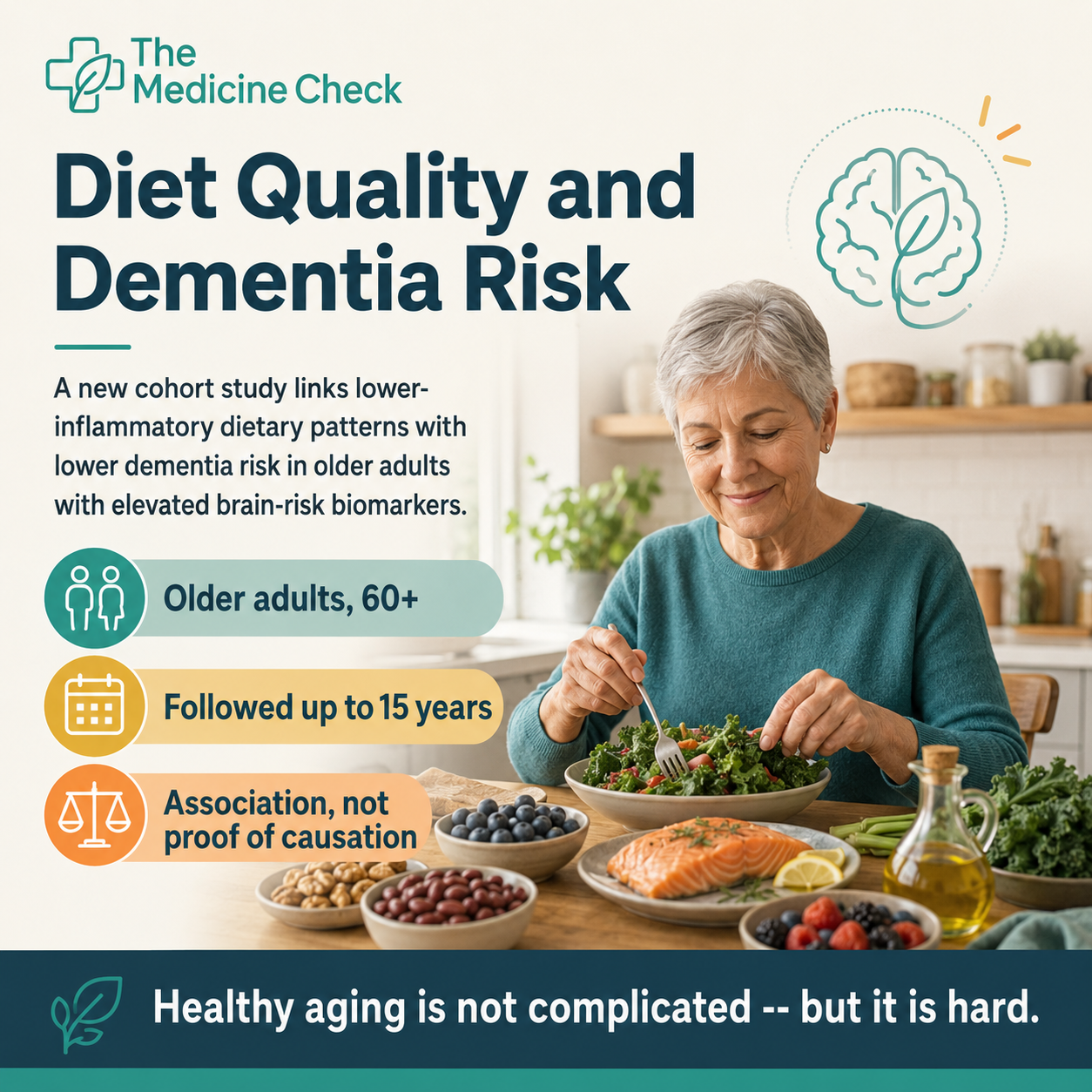
Editorial infographic about diet quality and dementia risk, showing an older adult with whole foods and callouts for adults 60 and older, long follow-up, and association rather than proof of causation.
The healthspan question hiding inside this study
Dementia prevention is often framed as a race against biology: amyloid, tau, genetics, age, and other risks that can begin years before symptoms. This week’s strongest Healthspan development offers a more practical question: if early biological risk markers are already present, do everyday prevention habits still matter?
A new cohort study published June 25, 2026, in JAMA Network Open suggests the answer may be yes, with an important caveat. Among 1,865 dementia-free adults age 60 and older in Sweden, higher diet quality was associated with lower dementia risk over long-term follow-up. The most consistent signal among people with elevated blood biomarkers linked to Alzheimer pathology and neurodegeneration was seen for a dietary pattern with lower inflammatory potential.
That is not the same as proving that diet prevents dementia. But it is a useful healthspan story because cognition is not only about future diagnosis. It is about independence, medication management, driving, finances, social connection, mobility, and quality of life. Brain health is one of the pillars that determines whether longer life stays functional.
What the new study actually found
The study used data from the Swedish National Study on Aging and Care in Kungsholmen, a population-based cohort that enrolled adults age 60 and older and followed participants for up to about 15 years. Researchers looked at repeated measures of diet quality over six years and compared them with later dementia outcomes.
The study also stratified participants by blood biomarkers: phosphorylated tau at threonine 217, or p-tau217, which is linked to Alzheimer disease pathology; neurofilament light chain, or NFL, a marker of nerve-cell injury; and glial fibrillary acidic protein, or GFAP, a marker related to glial activation or injury. These blood markers are increasingly important in dementia research because they can signal elevated neurobiological risk before a person has dementia.
Over a mean follow-up of 8.4 years, 240 participants developed dementia. Higher adherence to healthier dietary patterns was associated with lower dementia risk, but the pattern differed by biomarker level. Among participants with elevated p-tau217, NFL, and GFAP, the most consistent inverse association was with the reversed Empirical Dietary Inflammatory Index, a measure that reflects lower inflammatory potential in the overall diet.
For that lower-inflammatory dietary pattern, each one-standard-score increase in adherence was associated with lower dementia risk among people with elevated p-tau217, NFL, and GFAP. The reported hazard ratios were 0.71, 0.79, and 0.73, respectively. In plain English, the study found a meaningful association between lower-inflammatory diet quality and lower later dementia risk among older adults who already appeared biologically higher risk.
Why this is useful, but not definitive
The evidence verdict is moderate. This was a large, careful, population-based cohort study with long follow-up, repeated dietary assessment, clinical dementia outcomes, and blood biomarker stratification. It also fits with broader evidence that cardiovascular, metabolic, inflammatory, and lifestyle pathways are related to brain health.
But it was still observational. People who eat higher-quality diets may differ in many other ways: physical activity, education, income, sleep, social connection, access to care, smoking, alcohol use, chronic disease management, and overall health behavior. The researchers adjusted for many factors, but no cohort study can fully remove the possibility that healthier diet is partly a marker for a healthier life context.
The study was conducted in older adults in Sweden, so the results may not generalize perfectly to every population, food environment, culture, income level, or racial and ethnic group. Diet was measured with dietary-pattern scores rather than a randomized meal plan. Biomarkers were measured at baseline, and the field of blood-based Alzheimer testing is still evolving. The findings should guide prevention thinking, not drive self-diagnosis or a one-size-fits-all diet prescription.
The practical meaning for healthy aging
The most useful takeaway is not “eat this way and you will not get dementia.” That would overstate the evidence. A better takeaway is this: brain-health prevention does not end just because risk markers, age, or family history enter the picture. The everyday inputs that support vascular health, metabolic health, inflammation control, and function may still matter.
A lower-inflammatory, higher-quality dietary pattern usually points in a familiar direction: more vegetables, fruits, legumes, whole grains, nuts, fish or other healthy protein sources, unsaturated fats such as olive oil, and fewer ultra-processed foods, refined grains, sugary drinks, and highly saturated-fat-heavy patterns. The exact diet does not have to be exotic. The pattern matters more than any single food.
This also connects to the broader dementia-prevention evidence. The 2024 Lancet Commission emphasized that dementia risk is shaped across the life course by multiple modifiable factors, including blood pressure, diabetes, physical inactivity, smoking, obesity, hearing loss, social isolation, depression, excessive alcohol use, air pollution, vision loss, traumatic brain injury, education, and LDL cholesterol. Diet is not the whole map. It is one piece of a larger healthspan plan.
A simple brain-health nutrition check-in
For a general reader, the next step is not a biomarker test or a drastic diet overhaul. It is a simple annual nutrition check-in alongside the other healthspan basics.
Ask: how many meals each week are built around plants, beans, whole grains, nuts, fish, or lean protein? How often are ultra-processed foods, sweets, refined grains, and fried fast foods the default? Is blood pressure being measured and managed? Is A1C or fasting glucose being followed when appropriate? Are hearing, vision, sleep, physical activity, and social connection getting the same attention as supplements and headline-grabbing longevity claims?
For readers who want a structured place to review those patterns, the Annual Wealthspan + Healthspan Checkup Tracker can help organize the yearly view of brain, metabolic, mobility, and prevention signals: https://www.themedicinecheck.com/annual-wealthspan-healthspan-checkup-tracker
Anyone with cognitive symptoms, major dietary restrictions, diabetes, kidney disease, weight loss, swallowing problems, frailty, or complex medications should personalize nutrition decisions with a clinician or registered dietitian. The goal is not perfection. It is a sustainable pattern that supports the brain, heart, muscles, metabolism, and independence over time.
The bottom line
This week’s best Healthspan evidence does not prove that diet can override Alzheimer biology. It does suggest something more grounded and still hopeful: diet quality may remain relevant even among older adults with biological signs of higher dementia risk.
For healthy aging, that is the right level of message. Cognitive resilience is built from many small, boring, repeatable inputs: food patterns, movement, blood pressure control, sleep, hearing and vision care, medication review, social connection, and ongoing medical follow-up. None is magic. Together, they are the work of preserving function.
Keep Building Your Healthspan
Track your yearly progress with the Annual Wealthspan + Healthspan Checkup Tracker.
If medications are part of the story, review your list with the Anticholinergic Burden Calculator.
-
Mrhar A, Carballo-Casla A, Grande G, et al. Diet Quality and Dementia Risk in Older Adults With Alzheimer Pathology. JAMA Network Open. Published June 25, 2026. doi:10.1001/jamanetworkopen.2026.20254. https://jamanetwork.com/journals/jamanetworkopen/fullarticle/2850780
Charisis S, Scarmeas N. Diet and Dementia Risk in Individuals With Prevalent Neuropathology. JAMA Network Open. Published June 25, 2026. https://jamanetwork.com/journals/jamanetworkopen/fullarticle/2850781
World Health Organization. Risk reduction of cognitive decline and dementia: WHO guidelines. Published January 1, 2019. https://www.who.int/publications-detail-redirect/risk-reduction-of-cognitive-decline-and-dementia
Livingston G, Huntley J, Liu KY, et al. Dementia prevention, intervention, and care: 2024 report of the Lancet standing Commission. The Lancet. 2024;404(10452):572-628. doi:10.1016/S0140-6736(24)01296-0. https://www.thelancet.com/journals/lancet/article/PIIS0140-6736(24)01296-0/fulltext
Wu L, Sun D. Adherence to Mediterranean diet and risk of developing cognitive disorders: an updated systematic review and meta-analysis of prospective cohort studies. Scientific Reports. 2017;7:41317. doi:10.1038/srep41317. https://www.nature.com/articles/srep41317
Liu YH, Gao X, Na M, Kris-Etherton PM, Mitchell DC, Jensen GL. Dietary Pattern, Diet Quality, and Dementia: A Systematic Review and Meta-Analysis of Prospective Cohort Studies. Journal of Alzheimer’s Disease. 2020;78(1):151-168. doi:10.3233/JAD-200499. https://doi.org/10.3233/JAD-200499