

Your Wearable Might Catch Dementia Risk Clues Earlier Than You Think
A new JAMA Neurology study suggests that one week of sleep-wake and activity data can modestly improve dementia risk prediction in older adults, but it is not a diagnosis and it is not proof of prevention.
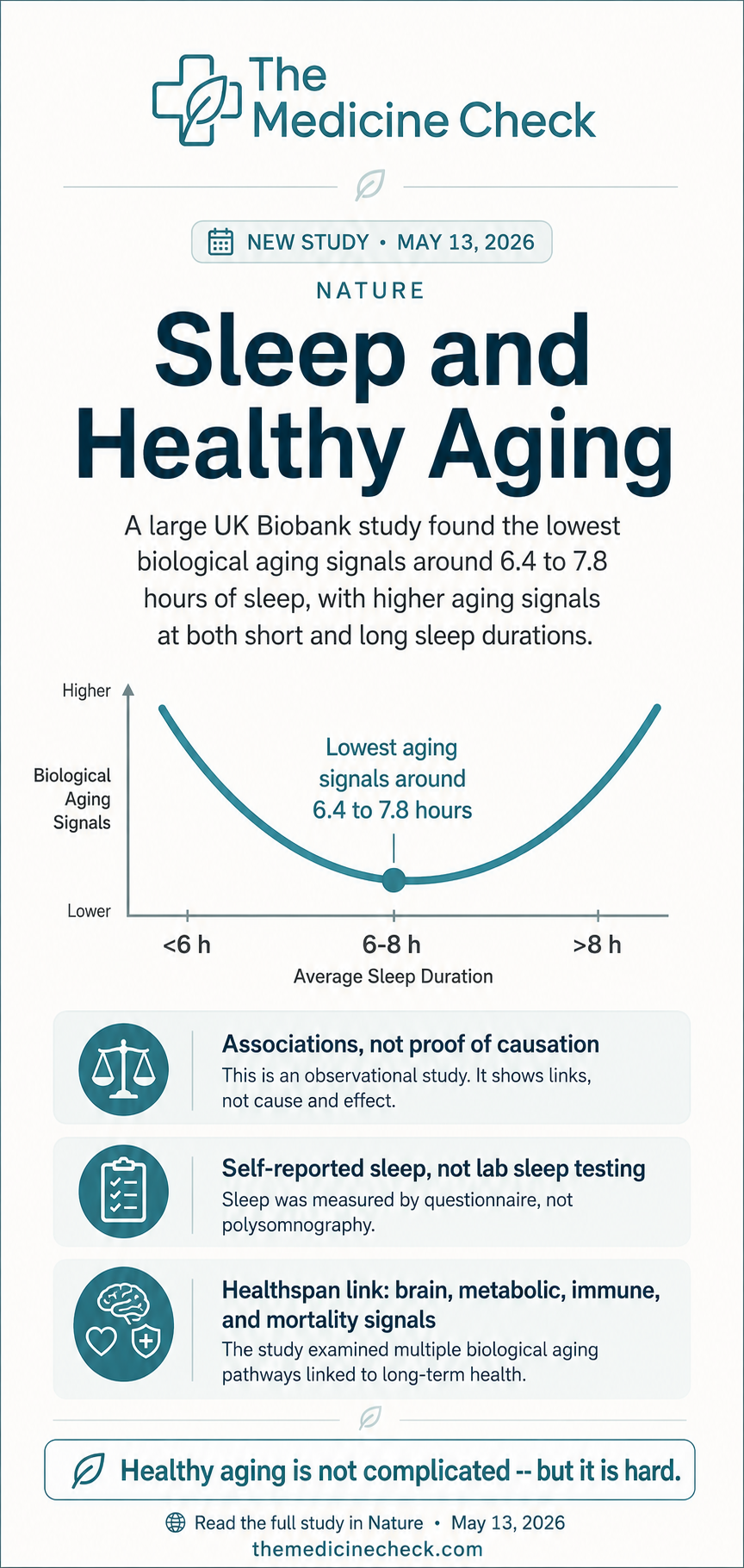
Editorial infographic for The Medicine Check summarizing a May 18, 2026 JAMA Neurology study showing that wearable sleep-wake and activity patterns modestly improved dementia risk prediction in older adults.
Most healthy-aging advice around sleep focuses on feeling better tomorrow. A new study suggests sleep and daily timing patterns may also tell us something about brain health years before dementia is diagnosed.
In a paper published online in JAMA Neurology on May 18, 2026, researchers analyzed wearable-derived sleep-wake data from adults 60 and older in two UK cohorts. The goal was not to see whether a single sleep habit causes dementia. It was to test whether a broader set of digital behavior signals could help identify who may be at higher risk.
The researchers used accelerometer data from 53,448 participants in UK Biobank and then tested their findings in 3,965 participants in Whitehall II. They pulled 36 measures from the devices, including daytime activity, sleep features, and timing patterns such as waking time and the rhythm of activity across the day. Using machine learning, they identified two main sleep-wake components that predicted future dementia.
What stood out is that the useful signal did not come from sleep alone. One component was driven mostly by poorer daytime activity patterns. The other reflected sleep disruption and earlier timing. When those components were added to a model that already included age and other known dementia risk factors, prediction improved modestly but significantly.
That matters because dementia prevention is still limited. If a low-friction, noninvasive tool like wearable data can help flag higher-risk adults earlier, it could make it easier to decide who should get closer follow-up, more formal testing, or more aggressive risk-factor management. From a healthspan perspective, that is the real value here: preserving cognition, independence, and function for longer.
Still, this is where restraint matters. The study does not show that a wearable can diagnose dementia. It also does not prove that changing your sleep schedule, walking more, or waking later will prevent cognitive decline. The authors themselves note that the signals they found may partly reflect very early disease changes already underway.
There are other reasons to be careful. The accelerometer data covered only one week, which may not reflect long-term habits. The UK Biobank group was healthier than the general population, which can limit real-world generalizability. The follow-up in the derivation cohort averaged about 7.8 years, which is useful, but dementia often develops over a much longer preclinical period. The study also lacked detailed sleep-disorder data, so it cannot tell us whether untreated sleep apnea, insomnia, or fragmented sleep explained part of the signal.
Even so, the study fits with a broader pattern in aging research: sleep and circadian disruption often travel with worse outcomes in cognition, frailty, and mortality. What is new here is the idea that combined wearable metrics may capture those risks more effectively than any single sleep number.
The practical takeaway is not “trust your watch to diagnose your brain.” It is simpler than that. If your daily pattern is drifting toward low daytime movement, fragmented sleep, and earlier or irregular timing, that may be worth paying attention to, especially in your 60s and beyond. Those are not just comfort issues. They may be part of a bigger brain-health picture.
Practical Takeaway
Healthy aging is not about chasing a perfect sleep score. It is about protecting the routines that support brain health over time: regular daytime movement, consistent sleep timing, and attention to major sleep problems if they show up. Wearables may become one more useful screening layer, but they are not a substitute for medical evaluation or established dementia risk reduction.
Sources
Cavaillès C, Danilevicz IM, Vidil S, et al. Digital Sleep-Wake Cycle Metrics and Dementia Prediction in Older Adults. JAMA Neurology. Published online May 18, 2026. DOI: 10.1001/jamaneurol.2026.1232.
Ma Y, Liang L, Zheng F, et al. Association Between Sleep Duration and Cognitive Decline. JAMA Network Open. 2020.
Liu HM, Xue Y, Tang K, et al. Association between sleep duration and frailty in older adults: Systematic review and meta-analysis of observational studies. Archives of Gerontology and Geriatrics. 2025.