

Pay Yourself First. But Don’t Forget to Live
“Pay yourself first” is one of the most common pieces of financial advice, and for good reason. It’s simple, effective, and foundational. Automate your savings. Invest for retirement. Treat your future like a priority, not an afterthought. As a physician and financial educator, it’s a principle I’ve long believed in and practiced consistently. By automating savings and retirement, you can set yourself up for a great future. Recommended levels are usually between 20-25% of your gross income, as this amount of savings can develop into quite a significant retirement savings if invested well.
But there’s a tension within that advice that we don’t talk about enough. What happens when saving for the future starts to crowd out living in the present?
In our household, “paying ourselves first” hasn’t changed. We continue to automate our retirement contributions and invest for the long term. That discipline remains our foundation. Our savings rate is still around 33% because of our goal to seek early financial independence. But what has changed is how I think about everything else.
Recently, my partner went through a serious diagnosis and surgery. It’s the kind of experience that forces you to zoom out quickly and reconsider what really matters. I speak with my patients about what matters all the time. In fact, it’s one of the key frameworks for patient care. In our case, we had prepared financially: we had an emergency fund, we had savings in our HSA, and we used them. In many ways, the system worked exactly as it should. But something shifted for me that went beyond the numbers. Before this, my instinct would have been to immediately rebuild. Refill the emergency fund as quickly as possible. Restore what was used. Get back on track. This time, that urgency felt different.
My partner has long wanted to return to the Alps for a hut-to-hut hiking trip. It’s not just a vacation, it’s something deeply tied to her love of the outdoors and the way she experiences the world. In fact, most of this website shows photos she took from our first trip to a little town called Mürren in Switzerland. And closer to home, since we moved back to Denver, she’s also wanted something simpler: a covered space on our back patio where she can sit, read, and enjoy everyday life.
Before her diagnosis, these were “someday” goals. Things we would get to after everything else was optimized. I have long considered myself an optimizer when it comes to finances. But now, I consider myself a satisficer (I wish I could take credit for these terms, I heard them first at the White Coat Investor). After her diagnosis, they no longer felt like things to delay. Despite the cost of an international trip and a home project, we made a conscious decision. We would continue to pay ourselves first (continuing our automated retirement savings), but we would also make space to live now. That meant budgeting for travel. It meant moving forward with the patio project.
I remember telling her during her recovery that completing the patio was important to me—not just to her. I said it out loud because I knew exactly how my more future-focused mindset would react. It would see the cost and immediately want to delay it. I would argue that the responsible thing to do was to wait and continue saving aggressively. But in that moment, I understood something more clearly than I had before.
Life doesn’t always wait.
Personal finance is often framed as a choice between being responsible and being indulgent. Save diligently or spend freely. Plan for tomorrow or enjoy today, but real life rarely fits into those extremes. For us, the goal isn’t to maximize every dollar or optimize every decision. It’s to align how we use our resources with what actually matters, both for our future and for our present.
We still save. We still invest. We still plan. But we’re also more intentional about creating a life we’re living right now, not just one we’re preparing for later. Her diagnosis changed many things. One of them was my relationship with time. And it reminded me that the goal of financial planning isn’t just to build a life you can enjoy someday.
It’s to build a life you’re already living.
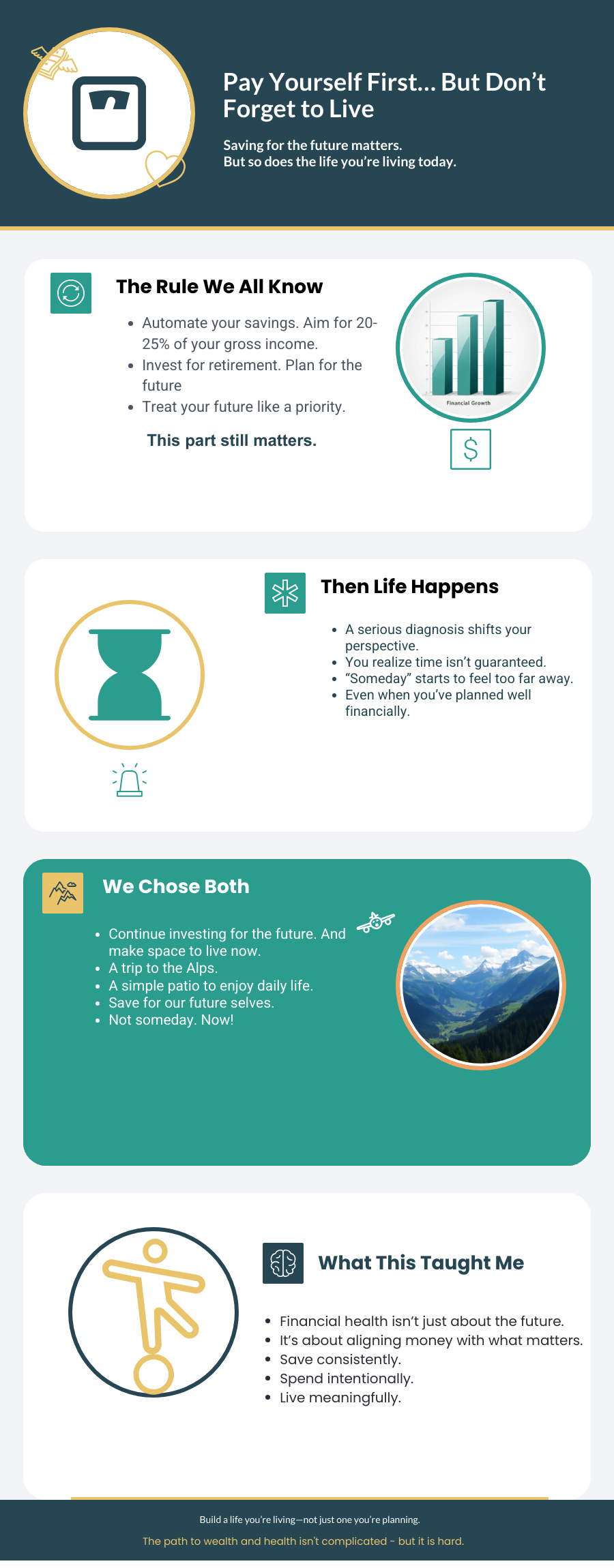
Pay yourself first infographic.